
Online Casino Game Shows in the UK: How They Work
 Available in GB
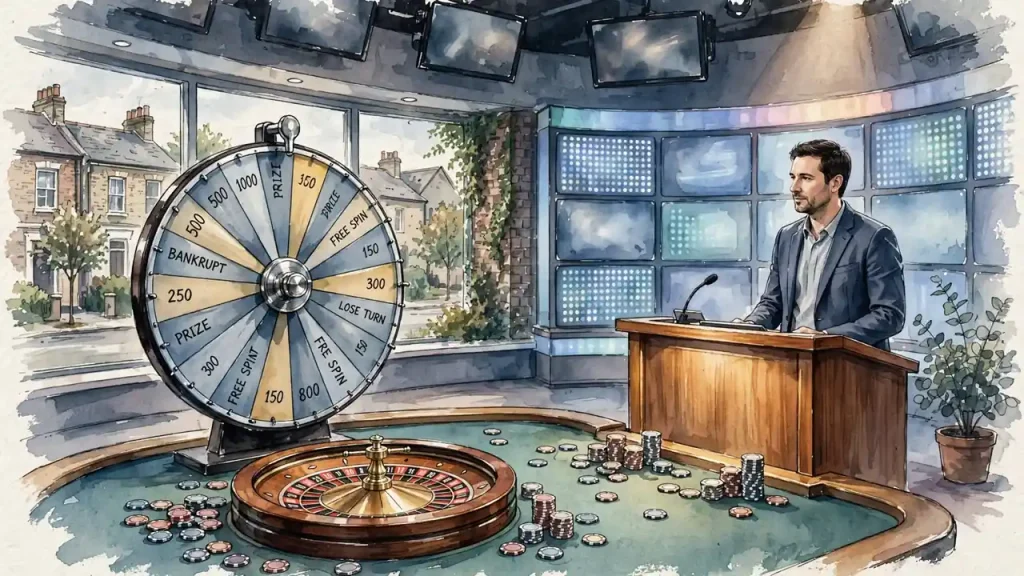
Live casino game shows combine a hosted studio broadcast with software that connects your selections to the result recorded for play.
How Live Casino Game Shows Work
A live casino game show combines a gambling game with a hosted broadcast. Instead of watching a virtual reel or dealing with a static interface alone, you see a presenter in a studio, follow a sequence of on-screen events and make decisions through the game interface. The broadcast supplies the visible action; software handles the connection between that action, your selection and the result recorded for your play.
The word “live” describes how the show is presented, not a guarantee that every part of the game is improvised or that you can influence its outcome. A presenter may introduce a round and explain what is happening, while cameras show a wheel, cards, a board or another piece of studio equipment. At the same time, the platform displays the available choices and lets you place a wager. The show and the betting interface work together, but they have different jobs.
That distinction helps explain why live casino game shows feel unlike standard online casino games. A conventional online slot, for instance, can run without a presenter or a broadcast. You make a selection, the game software generates a result, and the interface presents it. In a show format, the result is wrapped in a scheduled-feeling performance: a host speaks, events unfold on camera, and the software keeps the betting and game state aligned with the broadcast.
Slots: UK Online Casino Games and Providers
The three parts of the experience
It is useful to separate a live show into three interacting layers.
The broadcast is the video and audio you watch. It may include a presenter, studio set, physical game equipment, graphics and commentary. Its purpose is to make the round legible and entertaining. The presenter can describe the steps, announce a result or guide attention to a feature of the set. The broadcast is not, by itself, the mechanism that records your wager.
The game interface is the part you control. It presents the current betting options, the controls for selecting them and information about the round. Depending on the game, you may choose among outcomes or make a selection connected to an event in the studio. You submit your choice through the interface rather than by speaking to the presenter. The interface also shows whether a betting phase is open or closed.
The game system connects those inputs to the round’s result. It records the selection associated with your account, applies the game’s rules and displays the resulting outcome. The broadcast shows what happens in the studio; the system determines how that event maps to the choices shown in the interface and to the result of your play. The exact mechanics differ by title, so one show’s rules should not be assumed to apply to another.
These layers are coordinated, but they are not interchangeable. A host can explain a rule without changing it. A camera can show a physical event without letting viewers affect it. A screen animation can illustrate a result without being the underlying event itself. To understand a particular game, you need its own rules and interface, not just the way it is presented on screen.
Best Online Casinos with No Limits: UK Guide
What happens during a round
A typical round follows a sequence. First, the game presents the available choices. You decide whether to participate and, if so, select an option and enter a stake while the betting phase is open. The interface then closes betting for that round. After that, the show’s event takes place and a result is established. The game system applies the result to the selections made before betting closed and updates the interface.
This sequence matters because watching a live broadcast does not mean you can place or change a wager at any moment. A round has a point at which entries stop. If you have not submitted a selection before that point, the show may continue on screen while you wait for the next round. If you have submitted one, the selection is associated with the round in progress; seeing the event happen does not create a new opportunity to alter it.
The time between rounds is part of the format. It gives the host room to introduce what comes next, gives the interface a chance to display the current options and lets you decide whether to take part. The pace may feel more social than a self-contained digital game because the presenter and the broadcast occupy the interval. But the underlying sequence remains structured: options appear, entries close, an outcome follows and the system settles the round.
A live casino game show combines a gambling game with a hosted broadcast, where a presenter in a studio guides the action through a visible sequence of events.
A show can also include more than one stage within a round. The interface may distinguish a main selection from additional choices, or a result may lead into a further feature. Those details are title-specific. They do not change the basic division of responsibilities: the broadcast presents the action, the interface captures your choices, and the game system applies the rules.
Why the format feels different
The most visible difference is the human presentation. A presenter gives the activity a shared focal point and provides a running account of what is happening. Even when you watch alone, the broadcast can make the round feel like an event that other viewers are following at the same time. The host’s speech adds context and rhythm, but it does not tell you what your result will be.
The second difference is that the game is organised around a sequence you observe. In a standard digital game, you may trigger a result and immediately see the software’s response. In a live show, the event may take place after you have made your selection, so there is a visible interval between committing to a round and seeing its outcome. That interval is presentation, not evidence that the result is being decided in response to your behaviour.
The third difference is the role of the studio. Physical objects and camera angles can make an event easy to follow, while graphics can highlight possible outcomes or show how a round has progressed. Yet a visible wheel, card or other prop does not reveal every rule of the game. You still need to know what selections are permitted, when they close and how the result is interpreted. Visual clarity and rule clarity are related, but they are not the same thing.
Amatic Games at UK Casinos: How Access Works
This is why “live” should not be treated as a synonym for “more interactive” in every sense. You may interact with the game by making selections through the interface, but you do not necessarily control the studio event or communicate with the host. The amount and kind of interaction depend on the game’s design. The broadcast can invite attention; only the controls provided by the game determine what actions are available to you.
Live show versus standard online casino games
A useful comparison is to ask where the action comes from and how you encounter it.
In a conventional online slot, the interface is the whole visible game. Reels, symbols, animations and sound are generated for the screen, and you interact with the controls provided there. In a live show, the screen contains a broadcast as well as a betting interface. A presenter and studio create a continuous visual setting, while game controls remain separate from the video.
A standard digital table game may imitate familiar cards or a wheel, but it can operate entirely through software graphics and automated dealing or animation. A live show may place a human host at the centre of the presentation. That difference concerns how the game is delivered to you; it does not by itself establish that the rules are simpler, that the result is easier to predict or that the odds are better.
The broadcast
The video and audio you watch, including the presenter, studio set, and physical game equipment.
The game interface
The part you control, used to select betting options and view information about the round.
The game system
The mechanism that connects your inputs to the round’s result and applies the rules.
There is also a difference in attention. A self-contained game often waits for you to initiate an action and then presents its response. A hosted show asks you to follow a broadcast timeline: notice when a round opens, make any selection before the cutoff, and watch as the event develops. If you leave the screen during the round, you may miss the explanation or visual sequence, although the game’s rules still govern the result. The presenter helps with orientation, but you should not rely on commentary as a substitute for the written rules.
The interface is therefore especially important. It is where you can inspect the available options, see the status of the betting phase and understand how the game records your choice. If the broadcast and interface seem out of step, the controls and stated rules are the relevant guide to what you can do. A video stream is a presentation layer; it is not a second way to submit or amend a wager.
Broadcast timing and connection
Because a live show depends on a video stream, the picture and sound may be affected by the connection between the studio and your device. A delay in the video does not necessarily mean the game system has paused or that the betting window remains open. The interface indicates whether you can still enter the round. Treat its status, rather than the apparent position of the presenter on screen, as the practical signal.
A stream can also be interrupted or lose quality while the game interface remains visible. In that situation, you may be able to see controls without having a clear view of the event, or the broadcast may stop while the game state continues to update. What happens next depends on the game’s procedures and the platform’s handling of interruptions. Read the rules for the specific title so you know how a round is treated if the stream or connection fails.
Amatic Slots at UK Casinos: Games and Access
The reverse can happen too: the broadcast may continue while your device or connection prevents you from using the controls. Watching the event does not count as entering a round. A wager must be submitted through the interface within the period allowed by the game. If that has not happened, the system has no selection from you to apply to that round.
These are ordinary consequences of having two connected but distinct components: a video feed and an interactive game service. Keeping them conceptually separate makes the experience easier to interpret. The broadcast tells you what is being shown; the interface tells you what actions are available to you and whether your selection has been registered.
The presenter’s role
The host is an important part of the show’s presentation, but not a personal adviser. A presenter can announce the available phase, explain visible steps and keep the broadcast moving. Their remarks are directed to the audience as a whole. They do not know your account history or make decisions about your individual selection.
Commentary can also make a game feel more spontaneous than its structure actually is. A host may react to an event or build anticipation before a result appears, but that performance does not establish that the event was changed by the reaction. Nor does confidence, excitement or a particular style of delivery provide information about what will happen in a later round. The game’s rules describe how outcomes are determined; the presenter’s role is to communicate and stage the experience.
Do
- Submit your selection through the interface while the betting phase is open.
- Rely on the stated rules and interface to understand the game.
Don’t
- Expect to change a wager once the betting phase has closed.
- Treat the presenter’s commentary as a substitute for the written rules.
This distinction is useful when you compare titles. One show may use more conversation or visual explanation, while another may move quickly through its rounds. Those differences affect the viewing experience, but they are not a reliable measure of how favourable a game is. To compare mechanics, look at the rules and the choices the interface actually offers, rather than the energy of the broadcast.
What “best” can mean in this format
There is no single technical feature that makes a live casino show best for every player. The format involves several separate qualities: how clearly the rules are explained, whether the interface makes the betting phase easy to follow, how much of the action is visible, and whether the pace suits the way you prefer to play. These are practical differences in presentation and usability, not guarantees about results.
You can assess a show by observing how it handles a complete round. Can you identify the choices before betting closes? Is it clear when the game has moved from selection to result? Does the screen show how the outcome relates to the options you could choose? Are the written rules consistent with what the interface presents? Those questions help you judge whether you can follow the game without relying on guesswork.
It is also worth separating entertainment from the mechanics of gambling. A polished studio, familiar host or engaging theme can make a game more enjoyable to watch. None of those features changes the fact that you are placing a wager under the game’s rules. The broadcast can improve understanding when it explains a round clearly, but atmosphere should not be mistaken for a prediction method or a change in the underlying terms.
Amatic Online Casinos UK: Games, Licensing and Play
The phrase “online casino game shows” covers a format rather than one shared set of rules. A show can resemble another in its use of a host and live video while differing in its available selections, round structure and treatment of results. So the reliable way to understand any title is to follow the sequence in its own interface and read its rules before playing. That lets you distinguish what you see on screen from what the game actually records and applies.
In Great Britain, the Gambling Commission regulates commercial gambling, including remote gambling offered to consumers, and is the sole regulator for commercial gambling there. It issues operating licences to businesses and personal licences to individuals working in the sector. That regulatory framework concerns gambling activity and the people or businesses authorised to carry it out; it does not make the studio presentation itself a separate kind of game. A live show remains a casino game delivered through a combination of broadcast, interface and game system.
Recommended online casinos
- ChanzeBonus: Slots Welcome Bonus #1 200% up to €500 · Payout speed: 1-3 business days
- ZombillionBonus: Welcome Pack 250% up to £4000 + 200 FS · Payout speed: 1-3 business days
- NightWinBonus: £900 + 400 free spins · Payout speed: 1-3 business days
- WinBeastBonus: €5000 + 500 FS + €650 Freebet · Payout speed: 1-3 business days
- EvoSpinBonus: 125% up to €2500 + 125 Free Spins · Payout speed: 1-3 business days
- SlotoSportBonus: 500% up to £ 10 200+ 777 FS · Payout speed: 1-3 business days
- BritsinoBonus: Welcome Package – Get your £2,200 + 2,000 FS · Payout speed: 1-3 business days
- BeOnBetBonus: 100% up to €500 + 100 FS · Payout speed: 1-3 business days
- AmunbetBonus: Join now and get 450% up to 2,700 GBP + 450 FS · Payout speed: 1-3 business days
Finding Game Shows at UK-Licensed Casinos
To play a live casino game show for money in Great Britain, you access it through a casino operator that holds a UKGC licence. The operator provides the account and gambling service: it takes deposits, processes withdrawals, applies its published terms and handles customer support. The studio or software company behind a game may supply the product, but that does not make it the business responsible for your casino account.
Verifying the operator
- Identify the company that operates the casino account.
- Match that company to a current UKGC operating licence on the Public Register.
- Confirm the game is currently listed on the operator’s official site.
- Read the account, payment, and promotion terms.
- Set a financial limit before your first deposit.
This distinction matters when you compare places to play. A show title or provider logo in a casino lobby tells you what the operator lists; it does not, by itself, establish that the operator is authorised to serve British customers. A UKGC licence belongs to the gambling business and covers its regulated activity. It is not a general endorsement of every game in its lobby, nor a substitute for checking the operator’s own account and protection arrangements.
The operator is the route to play
A live show is not normally a standalone consumer gambling service. You reach it within an operator’s website or app, after creating an account and using that operator’s payment and account systems. This arrangement determines who sets the terms that apply to your play and who is responsible for administering them.
The UK Gambling Commission regulates commercial gambling in Great Britain. Businesses offering remote gambling to people there need the relevant UKGC licence even if their equipment or business premises are located elsewhere. The regulator issues operating licences to gambling businesses and personal licences to certain people working in the sector. For you, the practical point is that the casino operator—not the entertainment format—must be licensed to offer the gambling service.
Northern Ireland has a separate legal framework from Great Britain, so references to UKGC regulation should not be read as describing its rules. When checking a casino, make sure that the licence applies to the business and service you intend to use, rather than assuming that a familiar brand name or a show listing is enough.
Amatic Games at UK Casinos: Access and Play
A provider can supply software to a licensed casino without taking customer deposits or paying winnings itself. The operator remains the point of contact for account questions, transactions, bonus conditions and complaints about the gambling service. If you cannot tell which company operates the account, check the operator’s terms and legal information before registering.
Verify the casino, not just the game listing
A useful first check is whether the business named in the casino’s terms appears on the Gambling Commission’s Public Register with an appropriate current operating licence. Brand names and corporate names are not always identical, so compare the legal entity shown in the account documents with the register entry. Do not treat a provider’s licence, a game catalogue, or a promotional page as proof that the casino itself has permission to serve you.
This also helps distinguish regulated access from a site that happens to display the same sort of entertainment. A business based abroad may still need a UKGC licence if it offers remote gambling to consumers in Great Britain. A foreign licence alone does not put that business within the UKGC system. UK players are not criminally liable simply for using an offshore casino, but the site does not provide the same UK regulatory protections and routes for complaints and redress. It is therefore not a substitute for a UK-licensed operator.
The distinction is especially important when a site uses familiar game names or branding. Game availability does not determine the legal status of the account provider. Before depositing, identify the operator, confirm its UKGC licence and read the terms that govern the account. If the legal business is unclear or the licence cannot be matched to the service, do not infer that the casino is regulated from the appearance of its games.
Attention Do not assume that a foreign licence or a familiar game catalogue provides the same regulatory protections as a UKGC licence.
What a licensed operator must do around your account
A UKGC-licensed operator has responsibilities that begin before you play. It must prompt you to set a financial limit before your first deposit. A limit is an account-level control you choose to help manage how much you can spend; it is not a guarantee that gambling will be affordable or that losses will stop at a particular point. If you lower the limit, the operator must apply that reduction immediately. Do not assume the change will wait for a later review or take effect only after another deposit.
GamStop is another part of the regulated account environment. All online operators licensed in Great Britain have been required to participate since 31 March 2020. If you register with GamStop, the scheme is intended to prevent you from using participating operators for the selected exclusion period. It does not turn an unlicensed site into a participating casino, and an offshore operator should not be described as covered by GamStop or by UKGC dispute resolution.
These requirements apply to the operator, not to a particular game-show format. You should therefore assess the account controls before focusing on the entertainment offered. Read the operator’s information about limits, self-exclusion, support and complaints, and check that the details relate to the same company shown in its licence information. If you already use GamStop, do not create another account elsewhere as a way to bypass an exclusion.
Amatic Online Casinos in the UK: How to Find Its Games
The operator also has to give you clear information about its terms. That includes the conditions attached to promotions and how the account handles deposits and withdrawals. A headline offer is not a complete description of the deal: the detailed terms determine eligibility, timing and any restrictions. Check them on the operator’s own site before accepting an offer, and do not assume that two casinos apply identical conditions simply because they list similar games.
Comparing access without treating “best” as a safety label
There is no single operator that can be called best for every player on the basis of a game-show listing alone. Availability can change, and the same title may not appear in every casino lobby. A sensible comparison separates three questions: whether the operator is licensed for Great Britain, whether the show is currently available to your account, and whether the operator’s account conditions and protection tools suit your needs.
Start with the licence and legal entity. Then search the casino’s own games area for its live or show-style category, if it has one. A category label is a navigation aid, not a regulatory status. If you find a title through an external promotion, open the casino’s official site directly and confirm that the game is still listed there. This avoids relying on outdated descriptions or on a third party’s claim about current availability.
Next, review the account information that affects access. Check what identity details the operator requires, how it explains deposits and withdrawals, where it publishes bonus conditions, and how to contact support. Compare the operator’s financial-limit tools and GamStop information as part of the same assessment. These checks do not tell you whether you will enjoy a show; they tell you which business is providing the gambling service and what protections and terms accompany your account.
Assessing an operator
- Check the legal entity against the Gambling Commission’s Public Register.
- Verify that the specific game is available on the operator’s own site.
- Review account controls, including financial limits and GamStop participation.
- Understand that a game’s availability does not determine the operator’s legal status.
Do not treat search results, rankings, or a long catalogue as proof of suitability. A casino can list many games yet provide terms that do not fit your circumstances. Conversely, a smaller selection does not by itself indicate that the operator is unsafe. The relevant evidence is the operator’s current licence status, its published account terms and the protection measures available to customers.
A practical route from discovery to access
Use a short sequence before putting money into an account:
- Identify the company that operates the casino account, using its terms or legal information.
- Match that company to a current UKGC operating licence on the Gambling Commission Public Register.
- Confirm on the casino’s own site that the show you want is currently listed and accessible to your account.
- Read the account, payment and promotion terms before accepting an offer or depositing.
- Set a financial limit when prompted before your first deposit, and use GamStop if you need a gambling exclusion.
Each step answers a different question. The register check addresses the operator’s authority to serve the market. The casino lobby addresses current game availability. The terms explain how the account works, while the limit and GamStop tools concern how you control access to gambling. Keeping those checks separate prevents a game listing or marketing claim from standing in for the protections that should come from the operator.
If a casino cannot be matched to a current UKGC licence, do not treat a foreign licence or familiar game catalogue as an equivalent safeguard. If the operator is licensed but the show is absent from its own lobby, availability has not been established for that account. In either case, pause rather than relying on an old list or assuming that access will be the same across casinos.
Crazy Time and Funky Time: What the Facts Support
Crazy Time and Funky Time are names that may lead you to expect particular live casino shows. A title alone, however, does not tell you how a game works, what its rules are or where it can be played. Those details need to be established for each named game rather than inferred from the general category of live game shows.
Amatic Games in UK Online Casinos: What to Know
The distinction matters because a general description cannot stand in for a game’s specification. Live game shows may share a studio-style presentation, but that does not mean they use the same equipment, round structure, outcomes or rules. Nor does a game’s name establish whether it is a live production, a different type of casino game or a product offered by a particular operator.
What the names do—and do not—tell you
Searching for Crazy Time as a live casino game show or for a casino offering it does not, by itself, confirm a set of features or playing instructions. The same applies to Funky Time. Without reliable details tied to the specific title, claims about how a round begins, what actions a player can take, how results are determined or how winnings are calculated would be guesswork.
That also means you should not transfer rules from another show to either title. A familiar format or similar-sounding name is not evidence that two games share the same mechanics. If you are considering a named game, use the rules and information displayed for that game by the operator offering it. A general explanation of live shows can help you understand the category, but it cannot answer title-specific questions.
Crazy Time and Funky Time
Specific details regarding the rules, round structure, and outcomes of these titles must be obtained directly from the operator offering them, as a name alone does not provide technical specifications.
Availability depends on the operator
A game’s availability is a separate question from its identity or rules. In Great Britain, businesses offering remote gambling to consumers must hold the relevant UKGC licence. The operator provides the gambling service to the player; a game title appearing in a discussion or search result does not establish that a licensed operator currently offers it.
For Crazy Time or Funky Time, do not treat a general statement about live casino access as confirmation that either title is available to you. Availability can only be established by checking the current offering of the operator you intend to use. The operator’s game listing and the information shown when you open a title are more relevant to that question than a broad description of live game shows.
The licensing distinction is important, but it does not fill in game-specific details. A UKGC licence concerns the operator’s authority to provide remote gambling in the market; it does not, on its own, confirm the rules, presentation or current availability of every title a player might look for. Keep those questions separate: who is offering the game, whether the operator is licensed for the market, and what the game’s own displayed rules say.
How to assess a named title
When a title is available in an operator’s lobby, inspect the game information before deciding whether to play. Confirm that the name matches the game you intended to open, read its displayed rules and check how the operator explains the available choices and outcomes. If the title is not listed, do not assume that another operator offers it or that a similarly named game is equivalent.
Amatic Games at UK Online Casinos: How They Work
This approach avoids a common reasoning error: treating category knowledge as title knowledge. Knowing that live game shows exist does not establish that Crazy Time or Funky Time follows any particular format. Knowing that UK-licensed operators can offer remote casino games does not establish that a specific title appears in a specific casino. Each claim needs its own basis.
The same caution applies to descriptions that present a game as a particular kind of show or promise a particular experience. Unless the details are attached to the title itself and supported by the operator’s information, they should not be taken as a description of its actual play. A name can identify what you are looking for; it cannot substitute for the rules.
Use the broader live-show category only to understand the general setting. For decisions about Crazy Time or Funky Time, rely on title-specific information from the operator offering the game, and treat availability as something to confirm there rather than infer from the name.
Live Show Play Within UK Online Gambling Rules
A live casino game show is still remote gambling when you take part for money through a UK-licensed operator. The entertainment format does not create an exception to the rules that apply to online play. Some safeguards are specific to online slots, however, so they should not be treated as universal limits for every live game.
Slot stake limits are not show-wide limits
For online slots, the maximum stake per game cycle depends on your age. If you are aged 25 or over, the cap is £5 per cycle; if you are aged 18 to 24, it is £2. The first cap took effect on 9 April 2025, and the lower cap for younger adults followed on 21 May 2025.
Slot limits
Note that age-based stake caps apply specifically to online slots and do not automatically govern every live-show style product.
These limits apply to online slot play, not automatically to every product presented in a live-show style. A visual resemblance or a casino’s broad category label does not determine which rule applies. The relevant distinction is the type of gambling product: the stated caps are for online slots. You should not assume that a slot-specific limit governs a different game merely because it is delivered online or includes a host.
The cap is measured per game cycle, rather than by looking only at the amount you have deposited or the total spent over a session. For a slot, the cycle is the unit of play to which the stake limit applies. If you are comparing products, separate the game’s format from its regulatory category before using the slot cap to assess a stake.
Bonus wagering has a separate ceiling
A bonus can come with a wagering requirement: a condition that says how much qualifying play must take place before bonus funds, or related winnings, can be withdrawn. The UK Gambling Commission’s cap limits wagering requirements on bonus funds to 10×. This rule took effect on 19 December 2025.
That cap concerns the requirement attached to bonus funds. It is not a stake limit, a promise that a bonus will be offered, or a description of any particular show. The operator’s published terms still matter: they explain which funds the requirement covers and how it is applied. Read those terms before accepting an offer, rather than assuming that all promotions work alike.
Keeping these controls separate makes the terms easier to interpret. A stake cap limits a wager in a defined product category; a wagering cap limits the playthrough condition attached to bonus funds. One does not replace the other, and neither tells you what a live-show game’s rules are.
Amatic Slots at UK Casinos: Games and Access
Slot design rules affect how play proceeds
UK online slot rules also govern the pace and automation of play. Autoplay is prohibited, and a minimum interval of 2.5 seconds must pass between spins. These requirements constrain slot operation: you cannot set a sequence of spins to run automatically, and each new spin must respect the prescribed interval.
They are not general timing rules for every live casino broadcast or every game with a presenter. Their scope is online slots. If a product is not a slot, these particular design requirements should not be presented as features of its round structure. Conversely, a slot does not fall outside the rules because it is shown in a more theatrical setting.
This distinction matters when a live-show casino offers different kinds of games in one interface. The interface may make products appear connected, but regulation attaches to the gambling activity, not simply to the screen layout. A slot-specific restriction should therefore be applied to slot play, not transferred to unrelated products without a basis.
How to read the rules before playing
When you review a product, identify what kind of gambling it is before interpreting a limit. Then separate the questions: what stake rules apply to that product; whether you are using bonus funds and what wagering condition applies; and whether slot-design controls are relevant. This avoids treating one rule as a general description of all live entertainment.
For slot play, the age-based stake cap, ban on autoplay and minimum interval between spins are distinct controls. For bonus funds, the 10× ceiling concerns the wagering requirement. None of these rules establishes a show’s mechanics, outcome or available features. They define constraints around particular forms of online play and promotional terms.
A clear understanding of those boundaries lets you assess the stated terms without inferring rules from a game’s presentation. If a casino groups a slot and a live-hosted product under the same entertainment label, check the product category and its terms separately; the label alone does not extend slot rules to the whole group.
Are Amatic games licensed and legal to play in the UK?
Yes. Amatic Industries holds a UK Gambling Commission remote gambling software licence, and its games are offered to UK players through UKGC-licensed casino operators.
Must a casino be Gambling Commission-licensed to offer Amatic slots to UK players?
Yes. To offer online gambling to consumers in Great Britain, a casino must hold a UK Gambling Commission licence; Amatic’s software licence does not replace the operator’s licence.
Which licensed UK casinos carry Amatic slots?
Amatic games are listed at UK operators including Betfred, Bet365, William Hill, 32Red, Sky Vegas, PokerStars, Ladbrokes, Paddy Power, Unibet, Virgin Games, Betway, Betvictor, Betfair, 888casino, Jackpotjoy, kwiff and Casumo. Check the casino’s current game list before depositing, as availability can change.
Are Amatic casinos safe and regulated in the UK?
Amatic does not operate consumer-facing casinos. If you play its games, choose a casino licensed by the UK Gambling Commission, which regulates online gambling offered to consumers in Great Britain.
Slots
Published by the non Gamstop slots UK team.