
Crypto Payments at Non-GamStop Slot Sites
 Available in GB
Crypto Deposit Options for UK Slot Players
The first question almost every reader asks me about a non-GamStop site is not “Is it safe?” and not “What are the slots like?” The first question is “How do I actually get money in and out?” That question carries more weight than the others combined, because licensing concerns and library questions become academic the moment a deposit fails at the cashier or a withdrawal stalls for ten days behind an undocumented review queue. Payment rails determine whether the site is usable at all, and they sort the offshore population more cleanly than any other operational dimension.
The benchmark from the regulated side of the market is worth holding in mind. Across June to September 2024, UKGC-licensed sites processed 96.3% of their 44.2 million withdrawal requests automatically, completed another 3.5% inside 24 hours, and held only 0.1% past the 48-hour mark. That is the reference standard against which every offshore quote is implicitly being compared, and almost no non-GamStop operator matches it on the automation dimension because almost none have invested in the same payout infrastructure. What the better non-GamStop sites have done instead is route around the gap — and the most common route, by some distance, is crypto.
The UK player population is increasingly comfortable with that route. Survey data attributes 5.8% of UK gamblers to VPN use for access to gambling sites, with a further 2.2% playing exclusively through social platforms and messengers, and the share of that population using crypto rails to fund offshore play has risen steadily across the past three years. The rails are not optional any more — they are a primary distribution channel for the niche, with their own settlement characteristics, their own regulatory exposure, and their own risk profile. This article maps each rail in turn, starting with the full inventory and finishing with the risks specific to crypto routing.
The Full Payment Rail Map at Non-GamStop Slot Sites
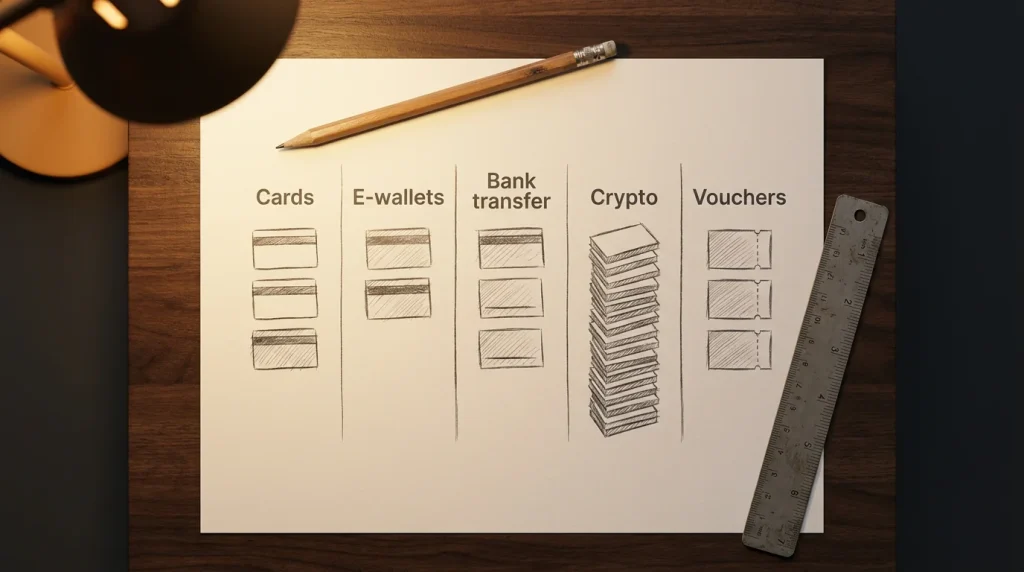
The rail inventory at a typical non-GamStop site falls into five categories, with substantial variation in coverage between operators. The categories are card payments (debit and credit), e-wallets, bank transfers (including instant-transfer schemes), crypto on-chain transfers, and a small residual category that includes voucher systems and phone-billing channels. Almost every operator covers cards and at least one e-wallet; coverage of bank transfer schemes varies by jurisdiction; crypto coverage is now near-universal at the upper tiers of the niche and patchy below them.
Cards are the most familiar rail and the most complicated one in the UK context. From April 2020 UKGC banned credit card use for gambling at its licensees, so card payments at UKGC sites have been debit-only since then. Non-GamStop sites are outside that perimeter and can in principle accept either. In practice, the card-processing layer at offshore operators is increasingly hostile territory — UK card issuers routinely block transactions identified as gambling-related to non-UK-licensed merchants, and the success rate on a card deposit attempt at a non-GamStop site sits well below 50% across the population I track. The card option is still listed because some attempts succeed; it is no longer the reliable rail it once was.
E-wallets sit in a middle bracket. The major regulated wallets enforce gambling-merchant policies that exclude non-UKGC operators for UK accounts; the smaller and offshore-friendly wallets remain available, with settlement characteristics that vary substantially by wallet. Bank transfer schemes — including instant-transfer rails — sit in a similar bracket: technically available, often friction-heavy, with rejection rates that depend on the bank’s enforcement posture rather than on the scheme’s technical capability.
Crypto rails are the segment that has changed most over the past three years and the segment that defines the niche’s payment landscape in 2026. Bitcoin, Ethereum and stablecoin support is now standard at the upper tiers of the population, with Lightning Network support an increasingly common addition for fast-settlement Bitcoin transfers. The reason crypto has expanded into this central role is structural: the rail does not depend on the cooperation of a third-party regulated intermediary that can refuse to process a transaction. The trade-off is that the rail comes with its own technical complexity, its own fee structure, and its own regulatory exposure under the UK’s evolving cryptoasset framework — all of which sit in the sections that follow.
The residual category — voucher systems, paysafe-style instruments, and pay-by-phone billing channels — covers the rails most often used by players who cannot access either cards or crypto. Each has narrow use cases and material limitations on deposit size and withdrawal availability; phone-billing channels in particular are usually deposit-only with no symmetric withdrawal path, which forces the player to elect a different rail for the cashout side regardless of how the deposit was made.
Recommended online casinos
- ChanzeBonus: Slots Welcome Bonus #1 200% up to €500 · Payout speed: 1-3 business days
- ZombillionBonus: Welcome Pack 250% up to £4000 + 200 FS · Payout speed: 1-3 business days
- NightWinBonus: £900 + 400 free spins · Payout speed: 1-3 business days
- WinBeastBonus: €5000 + 500 FS + €650 Freebet · Payout speed: 1-3 business days
- EvoSpinBonus: 125% up to €2500 + 125 Free Spins · Payout speed: 1-3 business days
- SlotoSportBonus: 500% up to £ 10 200+ 777 FS · Payout speed: 1-3 business days
- BritsinoBonus: Welcome Package – Get your £2,200 + 2,000 FS · Payout speed: 1-3 business days
- BeOnBetBonus: 100% up to €500 + 100 FS · Payout speed: 1-3 business days
- AmunbetBonus: Join now and get 450% up to 2,700 GBP + 450 FS · Payout speed: 1-3 business days
How a Crypto Deposit Actually Lands on a Slot Account
A crypto deposit at a non-GamStop site has more moving parts than a card deposit, and the moving parts matter because each one introduces a small probability of failure, fee, or delay. The end-to-end flow from “I want to deposit” to “the balance shows in my account” runs through four distinct stages, and understanding each stage is the difference between a smooth first deposit and a stuck transaction that takes hours to diagnose.
Stage one is the on-ramp. Unless the player already holds the cryptoasset, the first step is converting fiat to crypto at an exchange or on-ramp service. UK exchanges enforce FCA registration and know-your-customer requirements; the conversion itself takes between two minutes and several hours depending on the on-ramp’s verification status for the player’s account. The on-ramp typically charges a spread of 0.5% to 2.5% against the underlying market price, with stablecoin on-ramps usually at the tighter end and Bitcoin on-ramps at the wider end. The fiat-to-crypto conversion is the single most expensive step in the chain in fee terms.
Stage two is the wallet transfer. The crypto sits at the exchange wallet after the on-ramp completes, and most operators do not accept direct exchange-to-cashier transfers because exchanges can apply withdrawal holds and additional review on outbound transfers to flagged categories. The clean path is exchange wallet to player’s own self-custody wallet, then from self-custody to the operator’s deposit address. The intermediate self-custody step adds one network transaction with its own fee, but it removes the dependency on the exchange’s risk team during the deposit window.
Stage three is the on-chain settlement. The deposit transaction has to be confirmed on the relevant blockchain, with the operator typically requiring between one and six confirmations before crediting the balance. On Bitcoin’s base chain this means a wait of 10 to 60 minutes; on Ethereum, usually 2 to 5 minutes; on Lightning, near-instant; on stablecoins routed through Tron or other low-fee chains, between 1 and 3 minutes. The settlement window is the longest stage in the chain by default and the easiest to mis-set expectations around.
Stage four is the operator’s credit logic. Once the chain confirms, the operator’s wallet service has to recognise the deposit and credit the player’s account. This is usually automated and runs in seconds, but it can stall on operator-side issues — wallet service outages, address-allocation errors, manual review flags on unusually-sized deposits. The most common cause of an apparently stuck crypto deposit is not the chain; it is the operator’s credit logic catching the transaction in a review queue. Knowing this lets you direct support enquiries productively when the deposit does not show within the expected window.

BTC, ETH, LTC, USDT: Which Networks Are Offered & Why
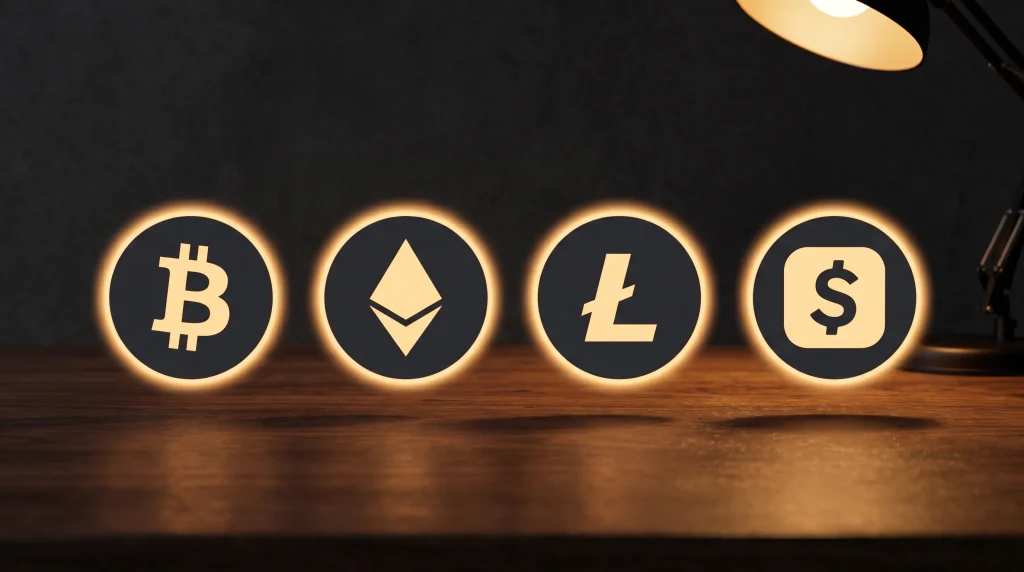
The crypto coverage at non-GamStop sites clusters around four assets with very different rail characteristics. Bitcoin is the universal anchor and the longest-supported; Ethereum is the second-most-common; Litecoin sits as a low-fee alternative to Bitcoin for smaller transactions; and stablecoins, principally Tether (USDT), have grown to become the volume leader at most operators that support them. The reason for the spread is mechanical — each asset solves a different problem in the deposit and withdrawal flow.
Bitcoin’s base chain offers the longest settlement times and the highest fees per transaction at peak network usage, which makes it suboptimal for small or frequent deposits. Lightning Network support changes the calculus entirely — Lightning settles in seconds with near-zero fees, and an operator that supports Lightning for Bitcoin deposits has made the rail genuinely competitive on speed against any other channel in the inventory. The reason Lightning is not universal is operator-side: integrating Lightning requires running or contracting a Lightning node, and not every operator has done so. Lightning availability is therefore a tier signal as well as a payment option.
Ethereum runs faster than Bitcoin’s base chain but has higher per-transaction fees during periods of network congestion. The asset is most useful at operators that also support ERC-20 stablecoins on the same chain, because the wallet infrastructure overlaps and the player can switch between Ethereum and USDT through a single deposit address. Litecoin solves the small-deposit problem that Bitcoin’s fee structure can create at low transaction sizes — settlement is faster than Bitcoin, fees are reliably small, and the asset has been a standard non-GamStop option for years.
Stablecoins, particularly USDT, have grown to dominate the crypto channel for a clear reason: they remove the price-volatility exposure that exists in the time gap between the deposit decision and the deposit settlement. A player depositing £200 of Bitcoin and waiting an hour for confirmations can find the balance credited at £190 or £210 depending on market movement during that hour; a player depositing £200 of USDT is depositing exactly £200, plus or minus the tiny basis spread that the stablecoin itself trades against the dollar. The volatility-elimination is why USDT is the preferred rail for any player who is using crypto as a payment mechanism rather than as a speculative position. The reason some operators accept stablecoins but not native Bitcoin is also mechanical — supporting USDT on Tron requires only basic wallet infrastructure, while supporting native Bitcoin requires more substantial node operation and reconciliation logic. The asset coverage of an operator’s crypto cashier therefore tells you something about the depth of their treasury operations as well as about their player-side feature set.
Crypto vs Cards vs E-Wallets: Real Settlement Times
The settlement-time comparison across rails is the most consequential operational difference between non-GamStop sites and their UKGC counterparts. UKGC’s 96.3% automated processing on 44.2 million withdrawals across mid-2024, with the additional 3.5% completing inside 24 hours, sets a benchmark that the offshore card and e-wallet rails almost never match. The offshore crypto rail is the only segment that can match or beat it.
Card withdrawals at non-GamStop sites typically settle in two to seven banking days, with substantial variance driven by the issuer’s gambling-merchant treatment of the inbound credit. Some issuers route the credit through manual review even after the operator has released funds, which can extend settlement by an additional two to three days. The card path is the slowest reliable rail in the offshore inventory; it works, but the worst-case settlement time can stretch into a fortnight if both the operator’s review process and the issuer’s manual review both fire on the same transaction.
E-wallet withdrawals settle faster than cards but slower than crypto in most configurations. The operator-side release is usually within 24 hours at the upper tiers of the niche, with the wallet-to-bank step taking an additional one to three banking days depending on the wallet provider. The total end-to-end window typically sits in the two to four day range. Some of the faster offshore-friendly wallets settle within 24 hours total, but those are a minority of the wallet population.
Crypto withdrawals settle on chain timescales — once the operator releases the transaction, settlement is governed by the underlying blockchain rather than by any banking intermediary. Bitcoin base-chain settlement runs 10 to 60 minutes; Lightning runs in seconds; Ethereum runs 2 to 5 minutes; stablecoins on low-fee chains run 1 to 3 minutes. The operator-side release window is the variable that matters here — at the better operators, release runs inside an hour; at the lower tiers, release runs in 6 to 24 hours; at the worst, release is held in undocumented review queues for days. The crypto rail’s settlement performance therefore depends almost entirely on the operator’s release discipline, because once the transaction broadcasts, the chain is faster than any banking rail can be. I cover the operators that consistently match or beat the regulated benchmark on this dimension when I look at withdrawal channels that consistently beat 24-hour benchmarks; the conclusion that pushes operators into that category is, almost without exception, disciplined crypto release.

Conversion Fees, Network Costs & Exchange Spread
The headline cost of a crypto deposit is the fee the operator displays at the cashier. The actual cost runs across at least four lines: the on-ramp conversion spread on the fiat-to-crypto leg, the network fee on the deposit transaction, any operator-side processing fee, and the symmetric chain on the withdrawal side. Each line is small individually; the cumulative effect on a £200 round-trip can run between 1% and 4% of the principal, and the larger end of that range is concentrated in the on-ramp and off-ramp legs rather than in the on-chain transfers.
The fee picture is also being reshaped by the wider UK tax change scheduled for the offshore-relevant side of the market. The Remote Gaming Duty rises to 40% from April 2026, which compresses operator margins at the regulated end and reshapes the relative economics of offshore play. The duty applies to UK-licensed operators rather than to offshore ones directly, but the resulting margin pressure on UKGC sites changes the comparative positioning of the offshore segment and indirectly influences the rate at which operators absorb or pass through payment-channel fees.
On the on-ramp side, the typical spread at FCA-registered exchanges sits in the 0.5% to 2% band for major assets, with stablecoin conversions usually at the tighter end. Some exchanges quote zero-fee deposits funded by a wide bid-ask spread on the conversion itself; the effective cost is identical, just hidden differently. The principled comparison between on-ramp services is not the headline fee — it is the all-in cost of converting £100 of GBP to the equivalent amount of the target asset and back, which is the only metric that translates directly into the player’s net position.
On the chain side, network fees vary by asset and by congestion. Bitcoin base-chain fees on a standard transaction at moderate congestion run in the £1 to £4 range; Lightning runs at fractions of a penny; Ethereum runs in the £2 to £10 range at moderate congestion; stablecoins on Tron run at fractions of a penny; stablecoins on Ethereum follow the same fee curve as native Ethereum transactions. For deposit sizes below £50, the chain-fee proportion can become significant on the base chains, which is one of the main reasons Lightning support and low-fee stablecoin chains have grown to such central importance in the niche.
FCA Cryptoasset Rules & What They Mean for UK Players
The UK’s regulatory perimeter on cryptoassets has tightened substantially across the past three years, and the tightening interacts with non-GamStop slot play in ways that most players underestimate. The simplest framing of the UKGC’s position on the broader unlicensed market came from Chief Executive Andrew Rhodes, who described it directly as The illegal online market is unsafe, unfair and criminal — that is why the Commission has invested heavily in this area in recent years.
The crypto rail is one of the principal vectors through which UK players reach that market, and the FCA’s evolving framework is increasingly the regulatory pressure point on the channel.
The FCA’s cryptoasset financial promotions regime, in force since October 2023, requires firms marketing cryptoassets to UK consumers to be FCA-authorised or to have their promotions approved by an authorised firm. Most offshore casino-targeted crypto on-ramps do not meet that standard; UK exchanges that do meet it are obliged to enforce KYC, source-of-funds questioning, and transaction monitoring against the same regulatory standards as other regulated financial services. The practical consequence is that a UK player using a UK exchange to fund an offshore gambling deposit is doing so through an intermediary that is monitoring the destination of outbound transfers, with regulatory consequences for the exchange if the destination pattern triggers anti-money-laundering thresholds.
The cryptoasset travel rule, in effect for UK-based virtual asset service providers, requires certain transaction information to accompany cross-VASP transfers above the regulatory threshold. The rule is not optional for the exchange, and exchanges that detect transfers to gambling-related counterparties at scale can and do close accounts or restrict outbound transfers. The interaction is not theoretical — multiple UK exchanges have publicly tightened their gambling-related outbound transfer policies across the past eighteen months, with corresponding friction on the player side.
The broader tax framework is also worth flagging. Crypto disposals by UK residents are within the scope of capital gains tax, with the disposal event including the use of crypto to fund any purchase or service. The technical reading is that converting Bitcoin to GBP at an exchange is a disposal; depositing Bitcoin directly to a slot operator’s wallet is a disposal at the moment of transfer at the prevailing market price; and the gain or loss against the original acquisition cost is reportable. Most recreational players in this niche operate below the annual exemption threshold and below the practical enforcement window, but the legal obligation exists and is not eliminated by the offshore destination of the funds.

Risks Unique to Crypto Rails at Non-GamStop Sites
The crypto rail introduces a category of risk that does not exist on the card or e-wallet channels. The principal exposures are wallet-side address errors, chain-side reorganisation risk, operator-side custody concentration, and the broader ecosystem-level risks that come from operating outside the traditional payment perimeter. Each is small in expected-value terms for a careful player; each is meaningful enough to deserve explicit attention.
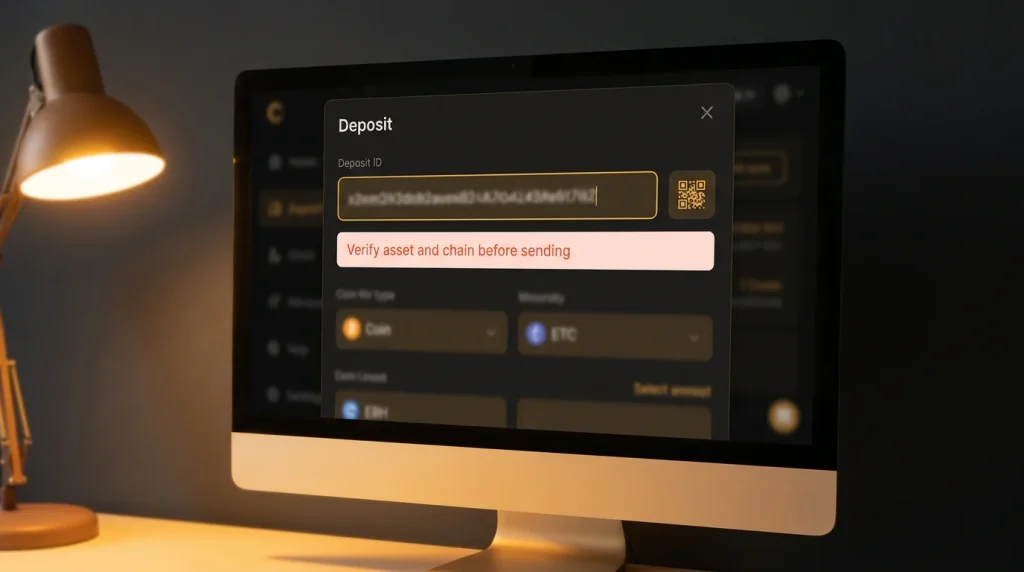
Address errors are the most common cause of permanently lost deposits in the niche. A crypto deposit is sent to an address generated by the operator at the moment of the deposit request, and an incorrect address — including an address from an old deposit request, an address for the wrong asset, or an address typed manually rather than copied — sends funds to a destination from which they cannot be recovered. The discipline that prevents address errors is to copy the destination address from the operator’s cashier on the same visit as the deposit, verify the asset and chain match exactly, and prefer QR codes or wallet integration over manual entry. The error rate on careful crypto deposits is essentially zero; the error rate on rushed ones is non-trivial.
Operator-side custody concentration is the structural risk specific to the non-GamStop architecture. The operator holds player balances in its own treasury wallets and is the sole custodian of those funds until withdrawal. There is no segregated-funds requirement equivalent to UKGC’s standards for licensed operators, no deposit insurance scheme equivalent to the FSCS for regulated financial services, and no third-party trustee structure for player balances at most offshore operators. The exposure to operator-side insolvency or fraud is concentrated and direct, with no fallback mechanism. The standard mitigation is to hold minimum balance at the operator and withdraw promptly after each session — a discipline that runs against the operator’s interest in retaining balance for re-wagering.
The ecosystem-level risks are the ones least visible to the individual player. Yield Sec and the Campaign for Fairer Gambling reported that 89% of views of illegal sports streams in the UK contained advertising for illegal gambling alongside embedded malware, spyware and keyloggers. The crypto rail is downstream of that ecosystem in the sense that crypto promotion appears disproportionately on the same channels, and players who follow promotional content from those channels into deposit decisions are operating in an environment where the surrounding software-security risk is materially elevated. The crypto rail itself is not the source of that risk, but the player journey that ends with a crypto deposit often begins inside that channel mix, and the cumulative exposure across the full journey is what matters rather than the rail in isolation.
Frequently Asked Questions
Are crypto deposits at non-GamStop slot sites covered by any UK consumer protection scheme?
No. The Financial Services Compensation Scheme covers regulated financial services and does not extend to deposits with gambling operators of any licensing status; UKGC”s operator standards on segregated funds do not apply to offshore operators; and there is no equivalent consumer-protection layer at the licence levels typically held by non-GamStop sites. Funds held at the operator”s cashier — whether in fiat or crypto — sit in the operator”s treasury with no fallback mechanism in the event of insolvency or fraud.
How long does a Bitcoin withdrawal from a non-GamStop slot site typically take?
The chain-side settlement on Bitcoin”s base layer runs 10 to 60 minutes once the operator releases the transaction; Lightning Network settlements run in seconds. The operator-side release window is the variable that matters most: at the upper tiers of the niche, release runs inside an hour; at the lower tiers, release takes 6 to 24 hours; at the worst, release sits in undocumented review queues for several days. Total end-to-end time is therefore almost entirely determined by the operator”s release discipline rather than by the blockchain.
Why do some non-GamStop slot operators accept stablecoins but not native Bitcoin?
Supporting USDT on a low-fee chain like Tron requires basic wallet infrastructure; supporting native Bitcoin requires more substantial node operation and reconciliation logic, particularly if the operator wants to add Lightning support for fast settlement. The asset coverage of an operator”s crypto cashier therefore reflects the depth of its treasury operations as well as its player-side feature decisions. Operators with stablecoin-only crypto support are typically running on third-party wallet infrastructure rather than maintaining their own.
Will a UK bank flag a card payment routed through a crypto on-ramp to a non-GamStop slot site?
UK card issuers monitor gambling-related transactions and can block or refer outbound payments to non-UKGC-licensed merchants. A card payment to a regulated FCA-registered crypto on-ramp is generally processed normally, since the immediate counterparty is the on-ramp rather than a gambling operator. The subsequent crypto transfer to a gambling destination is not visible to the card issuer. Some issuers monitor the on-ramp pattern itself and may apply additional scrutiny to repeated transfers to crypto exchanges; this varies by issuer rather than being a universal policy.
Players who prefer decentralized networks should review the deposit flow and speed of Bitcoin slots not on GamStop to minimize transaction delays.
Discover more about alternative payment methods and operator reviews at the leading non-GamStop slots portal.
Payments
Written by the editors at non Gamstop slots UK.