
High RTP Slots Not on GamStop and Verified Payouts
 Available in GB
Evaluating Payouts in High RTP Slots
A reader emailed me last spring to ask whether the 98.6% RTP on 1429 Uncharted Seas at his preferred non-GamStop site meant he was likely to come out ahead over an evening’s play. The answer is no, and the gap between the question and the correct answer is the largest single source of misunderstanding I encounter in this niche. RTP is a long-run theoretical value computed across millions of simulated spins; it is not a forecast for any session, any week, or any reasonable measurement window a recreational player will actually generate.
The high-RTP shelf in slots starts at 97%, with the well-known reference titles being Mega Joker at 99% in its highest configuration, Blood Suckers at 98%, and 1429 Uncharted Seas at 98.6%. Those numbers describe the percentage of total wagered amount that the slot returns to players in aggregate, measured across the studio’s certification testing run. They are accurate as long-run statements and entirely unreliable as session-level predictions. A 99% RTP slot has a long-run house edge of one penny per pound wagered; that same slot, across a thousand-spin session at minimum stake, can return anywhere from zero to many multiples of the starting balance, with the distribution governed by the slot’s volatility profile and not by the RTP figure itself.
The reason this distinction matters at non-GamStop sites specifically is that RTP figures at offshore operators are more variable, more configurable, and more weakly disclosed than at UKGC sites. Three of the eight sections in this article exist because the same slot title can ship with different RTP values at different operators, the configuration is rarely visible without inspection, and the wagering structure on offshore bonuses substantially changes the effective RTP a player actually experiences. The rest of the page exists to give you the tools to read the configured number, weigh it against the variance profile, and understand what a high-RTP shelf is actually worth in practice.
Recommended online casinos
- ChanzeBonus: Slots Welcome Bonus #1 200% up to €500 · Payout speed: 1-3 business days
- ZombillionBonus: Welcome Pack 250% up to £4000 + 200 FS · Payout speed: 1-3 business days
- NightWinBonus: £900 + 400 free spins · Payout speed: 1-3 business days
- WinBeastBonus: €5000 + 500 FS + €650 Freebet · Payout speed: 1-3 business days
- EvoSpinBonus: 125% up to €2500 + 125 Free Spins · Payout speed: 1-3 business days
- SlotoSportBonus: 500% up to £ 10 200+ 777 FS · Payout speed: 1-3 business days
- BritsinoBonus: Welcome Package – Get your £2,200 + 2,000 FS · Payout speed: 1-3 business days
- BeOnBetBonus: 100% up to €500 + 100 FS · Payout speed: 1-3 business days
- AmunbetBonus: Join now and get 450% up to 2,700 GBP + 450 FS · Payout speed: 1-3 business days
RTP, Hit Frequency, Volatility: A Three-Variable Read
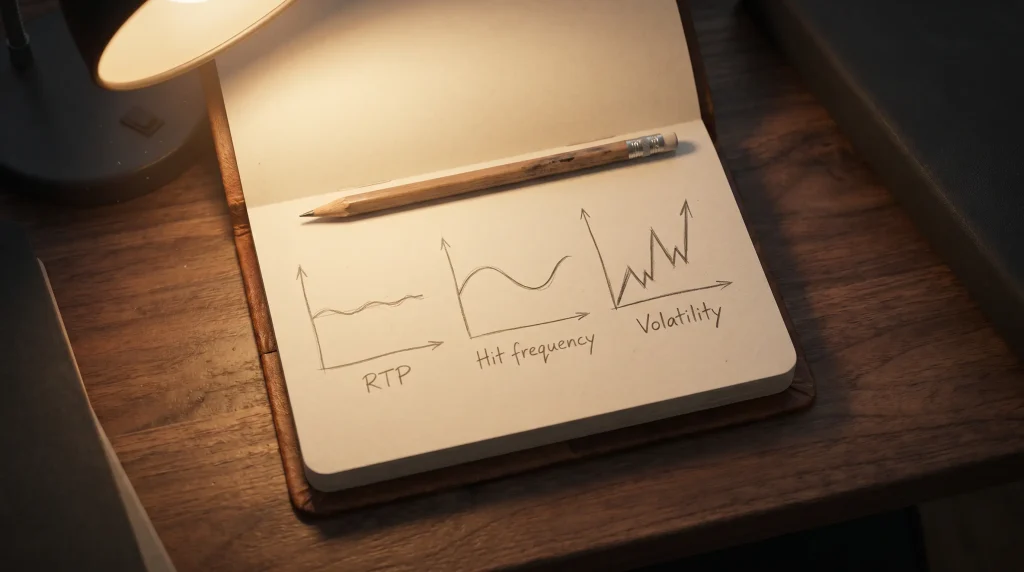
RTP is one of three variables that together describe how a slot behaves. The other two are hit frequency — the percentage of spins that return any winning combination, regardless of size — and volatility, which is a measure of how widely the returns cluster around the long-run RTP. Reading any one of these in isolation is misleading; reading all three together is the minimum viable framework for evaluating a title.
The numbers worth holding in mind are the reference points. Mega Joker at 99%, Blood Suckers at 98%, 1429 Uncharted Seas at 98.6%; these are the high-RTP anchors of the offshore catalogue. Hit frequencies across the broader slot population sit between 18% and 32%, with high-volatility titles clustering near the low end and low-volatility titles near the high end. The relationship between RTP and the other two variables is not deterministic, but the general pattern is that higher-RTP slots tend to have moderate volatility and moderate hit frequency, while ultra-high-volatility slots tend to have RTPs in the 94% to 96.5% band — the variance is concentrated in extreme outcomes rather than distributed evenly across spins.
That clustering produces an unintuitive consequence. A 99% RTP low-volatility slot pays back more reliably across short sessions; a 96% RTP high-volatility slot pays back more in extreme isolated outcomes. The “better” choice between the two depends entirely on what the player is optimising for. A bankroll-preservation strategy favours high RTP and low volatility; a max-win strategy favours moderate RTP and high volatility. The mistake to avoid is treating the RTP number alone as a quality ranking, because two slots with identical RTPs can have completely different behavioural profiles depending on where the variance is distributed across the paytable.
The non-GamStop catalogue makes this distinction more important rather than less. Offshore operators stock a much broader high-volatility shelf than UKGC sites — the high-variance Nolimit City and Hacksaw Gaming releases that dominate the offshore lobbies are deliberately built around extreme outcome distributions, which means an unwary player can pick a “high-RTP” recommendation from a generic top-list and end up on a title whose variance profile makes that RTP figure essentially irrelevant to anything they will experience inside a thousand-spin window. I cover that aspect of the niche in detail when I look at the volatility curve that sits behind any RTP figure. The honest read on RTP is that it is a useful number, that it ranks among the more reliable disclosures a studio makes, and that it tells you about one-third of what you need to know to evaluate a slot.
Configurable RTP: Why the Same Slot Can Pay 88% or 96%
The single most important fact about RTP on commercial slot titles is that it is configurable. The studio that builds a slot does not ship one RTP value; it ships a set of certified configurations, and the operator picks which configuration to deploy on its platform. The certified set is published in the slot’s regulatory documentation, the picked value sits in the game info panel if the operator chooses to display it, and the difference between configurations on a single title can be substantial. The most commonly cited configurable-RTP examples include slots with options spanning roughly 88% to 96.5% on the same title.
The motivation for the configurable architecture is commercial. Operators with thin margins prefer lower RTP configurations because the higher house edge compensates for the operator’s cost structure; operators with stronger margins can ship higher RTP configurations to attract and retain players who recognise the difference. UKGC’s market data for Q3 2025 to 26 — covering October through December 2025 — shows the regulated UK slot market hit an all-time GGY high of £788 million on 25.7 billion spins, which gives some sense of the underlying scale at which RTP configuration decisions translate into operator revenue. At non-GamStop sites the same configurability exists with materially less disclosure pressure, which is why the same title can ship at different RTPs at different operators without either being misrepresented.
The mechanics of who decides the value are straightforward and worth being precise about. The studio is the manufacturer; it certifies a set of configurations through an accredited testing house and makes the certified set available to operators through its B2B distribution channel. The operator is the deployment decision-maker; it picks one of the certified configurations and ships that configuration on its platform. The player sees the configured value only if the operator chooses to display it in the game’s info panel, and the operator is under no platform-level obligation in most offshore jurisdictions to do so.
This division of labour explains every “Why does this slot pay differently at different sites?” question I have ever received. The studio is shipping the same game; the operator is shipping different versions of the same game. The player needs to inspect which version they are on before treating any published RTP figure from a third-party source as applicable to the slot they have just loaded. The single highest-impact action a player can take to protect themselves from a low-configured ship is to open the game info panel before the first spin and verify the RTP value displayed there matches the studio’s flagship configuration. If the panel does not display an RTP value at all, the working assumption should be that the configuration is at or near the lower bound of the certified set.

Slot Titles With 97%+ RTP Found at Non-GamStop Sites
The 97%+ shelf is small, well-known, and stable across years. The titles that anchor it are produced by a handful of studios — NetEnt, Thunderkick, Play’n GO, Microgaming, Yggdrasil, and a few others — and they sit on the operator’s lobby at non-GamStop sites if the operator is carrying any meaningful breadth of the high-RTP catalogue at all. The reference points worth knowing by heart are Mega Joker at 99%, Blood Suckers at 98%, and 1429 Uncharted Seas at 98.6%; beyond those three, the shelf widens into a longer list of titles in the 97% to 98% band that are individually less well-known but collectively form the bulk of the high-RTP offering.
Mega Joker is the structural outlier. The 99% headline figure applies to its supermeter mode, which requires the player to enter the supermeter and play through it correctly; the base game RTP runs at a lower configuration, and most player turnover happens in base game rather than in supermeter. The title is therefore a 99% slot in the technical sense and an effectively lower-RTP slot in the typical-session sense, depending heavily on player behaviour. Blood Suckers is the cleanest 98% reference — straightforward five-reel structure, no supermeter mechanic, RTP calculation applies uniformly across the paytable, and it has shipped at the 98% configuration with consistency across most operators that carry it. 1429 Uncharted Seas is the high-water mark for “ordinary” high-RTP at 98.6%, again without the structural caveats that complicate Mega Joker.
Below the three anchors, the 97% to 98% band includes a much longer roster — Jackpot 6000 from NetEnt in its supermeter configuration, Devil’s Delight at 97.6%, Kings of Chicago at 97.8%, Lucky Angler at 96.4% but configurable upward, Bloodlords from Wazdan in its 96.7% default configuration with upward options. The reliable rule across this band is that the studio publishes the configured set and the operator picks one. The configuration on any specific site has to be verified at the title level — and the variance between operators on the same title at the same nominal RTP band is wider than most players assume.
The shelf below 97% is dominated by titles in the 96% to 96.5% range, which is the modal RTP band for slot releases industry-wide and the default configuration for most contemporary studio output. A non-GamStop site that does not stock the high-RTP shelf above 97% is not necessarily flagging a quality problem — that shelf is a small minority of the overall slot population — but it is signalling that the lobby is being curated around volume rather than around return characteristics. The serious-studio non-GamStop sites that I score highest in matrix reviews almost always carry the three anchor titles at their flagship configurations, along with at least ten other 97%+ titles, and they display the configured RTP in the game info panel without requiring the player to dig for it.

RTP by Provider: NetEnt, Thunderkick, Play’n GO, Nolimit City
RTP varies more by provider than by title, in the sense that each studio has a house style for where on the configurable range it ships its games by default. The four studios that anchor the high-RTP discussion at non-GamStop sites are NetEnt, Thunderkick, Play’n GO and Nolimit City, each with a distinct profile, and Pragmatic Play sits behind the volume question rather than the RTP one — Pragmatic held nine of the ten most-played slot positions in Q1 2025 with seven titles in the broader top twenty, which means their default-RTP norms shape the experience of the typical offshore player more than any other studio’s choices do.
NetEnt is the historical anchor of the high-RTP shelf. Their classic catalogue runs at consistently high RTPs by industry standards — Blood Suckers at 98%, Mega Joker at 99%, Jackpot 6000 in the same band — and the studio has built its brand around high-RTP positioning to the extent that operators carrying NetEnt at lower configurations are visibly going against the studio’s marketing posture. NetEnt RTP at MGA-licensed operators tends to ship at the flagship configuration; at Curaçao-licensed operators the picture is mixed, with some sites shipping flagship and others shipping the low-configuration option from the certified set.
Thunderkick sits in a similar bracket. 1429 Uncharted Seas at 98.6% is the flagship; the rest of the catalogue runs typically in the 96% to 97% band, with the studio’s overall identity built around moderate-volatility titles with above-average RTPs. Play’n GO covers the broadest range and the largest title count — their catalogue spans low-RTP commercial titles at 94% through to high-RTP rarities above 97%, and the breadth means a Play’n GO recommendation is meaningless without title-level RTP verification.
Nolimit City is the studio at the opposite extreme. Their catalogue is built around extreme-volatility titles with RTPs typically in the 94% to 96.4% band — the variance is concentrated in maximum win potential and feature-trigger frequency, not in long-run return. A high-RTP shopper looking at Nolimit City is generally looking in the wrong place; the studio’s value proposition is variance, not return. The honest provider-level read is that NetEnt and Thunderkick dominate the high-RTP shelf, Play’n GO crosses the entire spectrum and requires per-title checking, Nolimit City sits firmly outside the high-RTP conversation, and Pragmatic Play’s outsized share of overall player turnover means their typical RTP ship — usually 96.5% on flagship configurations, falling to 94% to 95% at operators choosing the lower-end configuration — defines the actual experience of most players in this niche.
How to Verify the RTP Configuration on a Live Slot
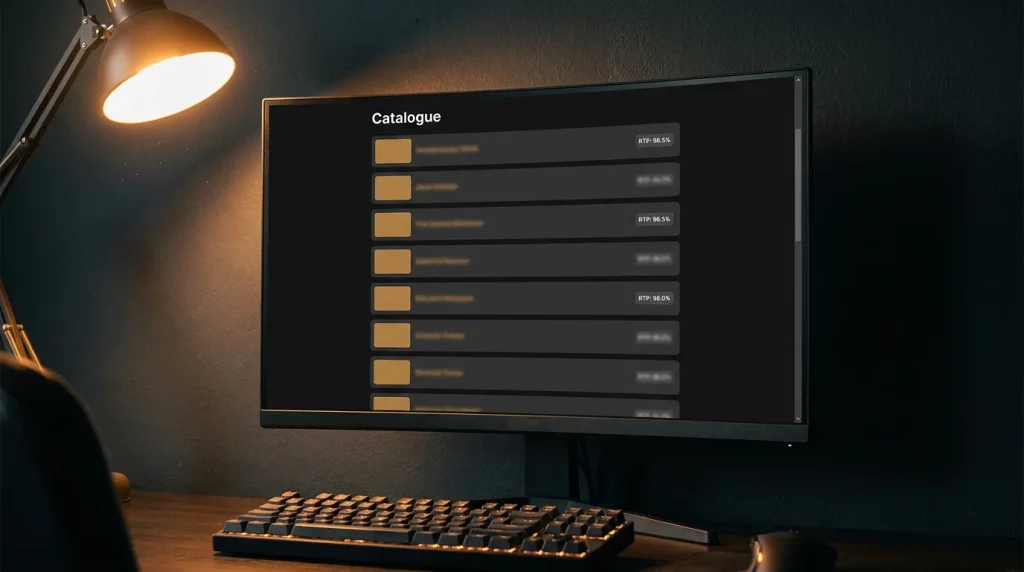
The mechanical procedure for verifying RTP on a live slot takes about ninety seconds per title. Open the slot, open the game info panel — usually accessed through the settings or help icon in the slot’s UI — and locate the “Theoretical Return to Player” or “RTP” line. The number displayed there is the configuration the operator has deployed. Compare it against the studio’s published flagship configuration for the title, which is usually findable through the studio’s own catalogue page or through reputable third-party slot databases.
If the operator has not displayed the RTP in the game info panel, the title is either configured at the lower end of the certified set or the operator has actively chosen not to disclose. Either interpretation is informative. The serious-studio non-GamStop operators that I weight highest in matrix reviews disclose RTP universally; the operators that do not disclose it cluster in the third tier of the population. The display question is itself a quality signal, separate from whatever the underlying number turns out to be.

A second-order verification method is to test the title at minimum stake across a fixed-spin sample and compare actual return against expected return. This is not a precise method — the sample sizes needed for statistical convergence on a percentage-point RTP question run into tens of thousands of spins — but it can identify gross misconfiguration where the deployed RTP is substantially below the displayed number. If a slot displays 96% in the info panel and a thousand-spin minimum-stake sample returns 70%, the sample is consistent with the displayed RTP given normal variance; if the same sample returns 30%, the gap is large enough to warrant a second sample, and a second sample at the same level is grounds to assume the displayed number is not accurate.
The third verification path is regulator-style — checking the studio’s RTP certification documentation directly. This is more relevant for analysts than for individual players, but it is worth knowing that the certifying testing houses (eCOGRA, GLI, BMM, iTech Labs) publish summary certification data and that the certified set for any commercial slot can be cross-referenced against the operator’s deployed configuration. Where the regulatory perimeter is at its tightest, frictionless verification is the norm — UKGC’s Financial Risk Assessment pilot, for example, found that 97% of checks completed seamlessly and the regulator projects less than 3% of active accounts will trigger an FRA at all. The verification load on the player at the offshore equivalent of that perimeter is materially heavier, which is why the ninety-second info-panel check is the minimum hygiene step.
How Bonus Wagering Erodes Effective RTP
A high-RTP slot played through a bonus wagering chain is not the same slot, in expected-value terms, as a high-RTP slot played from a bare deposit. The bonus structure imposes a turnover requirement that converts the slot’s house edge from a per-spin cost into a cumulative cost across the wagering chain, and the longer the chain, the more of the slot’s RTP advantage is consumed by the bonus itself.
UKGC’s 10x wagering cap from 19 December 2025, with subsequent rule updates on 19 January 2026, sets the regulated benchmark; the non-GamStop norm sits in the 35x to 45x band. Run a 99% RTP slot through a UKGC-cap 10x bonus and the expected loss across the wagering chain is 1% of the turnover multiple, which on a £100 bonus equals £10. Run the same slot through a non-GamStop 40x bonus on bonus-plus-deposit and the expected loss across the wagering chain is 1% of £8 000, which is £80. The slot’s 99% RTP — the highest configuration available in the entire commercial catalogue — has not been enough to offset the bonus arithmetic into positive expected value.
The interaction is sharper at lower RTPs. A 96% RTP slot through the same non-GamStop 40x bonus on bonus-plus-deposit produces an expected loss of 4% of £8 000, which is £320. The bonus credit was £100. The headline of “matched value” is reduced, after RTP and wagering interact, to an expected net loss against the deposit balance — and that is before any restriction-tripping or time-window failure.
The practical implication is that high-RTP titles are most valuable at non-GamStop sites when they are not being played through a wagering chain. The bare-deposit player on a 98%+ RTP slot is genuinely benefiting from the RTP advantage; the bonus-clearing player on the same slot is feeding the wagering arithmetic, and the RTP advantage compresses into a marginal improvement on a structurally negative position. The two highest-value patterns in this niche are bare-deposit play on the high-RTP shelf, and explicitly no-wagering promotions where the headline value translates directly into cash without a turnover requirement attached. Everything in between is a question of how much of the RTP advantage the wagering chain consumes.

Why a 99% RTP Slot Can Still Wipe a Bankroll
The most important sentence in this article is the one that follows: a 99% RTP slot is a slot with a 1% house edge in the long run, and the long run is much longer than any session a recreational player will produce. The variance distribution around the long-run RTP is wide; the probability of a sustained losing run inside a thousand-spin window is materially higher than most players intuitively assume; and the bankroll consequence of a sustained losing run is total, regardless of the RTP figure on the title that produced it.
The clinical data on UK gambling harm sets a useful frame here. NHS England’s Adult Psychiatric Morbidity Survey for 2023 to 2024 found that 0.3% of adults in England meet the clinical threshold for problem gambling, rising to 0.9% among those who gambled in the prior twelve months. The same survey identified 1.6% of adults as having a Problem Gambling Severity Index score of three or higher, indicating at least moderate risk. Those numbers describe the population in which sustained losing runs translate into sustained harm — and high-RTP slots are present in that harm picture in the same proportion as other slots, because the variance distribution does not stop existing just because the RTP figure is high.
The session-level reality is that a 99% RTP slot on a £500 bankroll at £1 stakes can produce a losing session of any magnitude up to the full bankroll, including across what would intuitively feel like a “should win” session window. The probability of a complete bankroll loss inside a thousand-spin session at level stakes on a moderate-volatility slot at 99% RTP is non-trivial — it sits in the low single-digit percentages depending on the variance profile of the specific title — and a “thousand-spin session” is several hours of real-time play, which is a window within reach of an evening’s session for a recreational player. The Gambling Commission’s Market Impact reading on session behaviour after the post-2025 stake caps observed that the inability to place large stakes is leading to players being less inclined to play for longer periods of time
, which is a regulatory acknowledgement of the same underlying dynamic — session length and stake size together drive how aggressively a bankroll meets variance, and no RTP figure overrides the interaction.
The honest framing on the high-RTP shelf is that it offers the best long-run return characteristics available in the commercial slot market, and that long-run does not protect against session-level variance. A 99% RTP slot is a better expected-value choice than a 94% RTP slot; a 99% RTP slot is not a winning slot. The distinction is the difference between “less likely to lose over a sufficient sample” and “likely to win in any given session”, and the bankroll consequences of misreading the distinction are real, immediate, and not offset by any RTP figure on any title.
Frequently Asked Questions
Does a 99% RTP slot at a non-GamStop site really pay back 99% per spin?
No, and that is the central misunderstanding about RTP. The 99% figure is a long-run theoretical value computed across millions of simulated spins during studio certification; it describes aggregate behaviour, not per-spin or per-session behaviour. Individual sessions on a 99% RTP slot can return any value from zero to many multiples of the starting balance, with the distribution governed by the slot”s volatility profile. The 1% house edge applies in the long run only, and the long run is much longer than any recreational session window.
How does configurable RTP work, and who actually decides the value an operator ships?
The studio that builds a slot certifies a set of RTP configurations through an accredited testing house and makes the certified set available through its B2B distribution channel. The operator picks one of the certified configurations and ships that version on its platform. The player sees the configured value in the game info panel only if the operator chooses to display it. The same title can ship at materially different RTPs at different operators without either being misrepresented, which is why per-site verification of the configured value is the only reliable check.
How does a slot"s volatility affect a high-RTP figure in practice?
Volatility controls how the long-run return distributes across spins. A high-RTP low-volatility slot returns close to its RTP across short sessions in a tight band around the average; a high-RTP high-volatility slot can return zero or many multiples of the average across the same sample window. Two slots with identical 97% RTPs can have entirely different session experiences depending on where the variance is concentrated. The RTP figure ranks long-run return; volatility ranks the breadth of the short-run distribution around that return.
Are high-RTP slots always available for bonus wagering at non-GamStop sites?
No. Most operators apply game weighting that contributes 100% from low-RTP and medium-volatility slots, between 10% and 25% from titles flagged as “advantage games” or sitting above a defined RTP threshold, and 0% from a third tier that often includes the highest-RTP titles outright. A player attempting to clear a wagering requirement on a 98% or 99% RTP slot often finds the title contributes nothing to the requirement, which makes the high-RTP shelf most valuable in bare-deposit play rather than bonus-clearing play.
Many players looking for high returns also enjoy the dynamic mechanics found in Megaways slots not on GamStop, which offer up to 117,649 ways to win.
To build a sustainable bankroll strategy, make sure to explore the comprehensive resources available on our top offshore slot sites platform.
Casino Games
Published by the non Gamstop slots UK team.