
Non-GamStop Slot Bonuses and Fair Wagering Terms
 Available in GB
Analyzing High-Value Casino Bonus Offers
The largest welcome offer I have ever seen at a UK-licensed slot site was £200 plus 50 spins. The largest I have seen at a non-GamStop site in the same week was £7 500 plus 750 spins. The first number is small because the architecture around it makes it real. The second is large because the architecture around it makes most of it unreachable. The difference between the two is the entire subject of this article.
Two regulatory shifts in particular set the gap. The first is the wagering cap UKGC imposed on its licensees from 19 December 2025, which limited bonus wagering to a 10x multiple, with rule updates following on 19 January 2026. The second is the broader regulatory perimeter that determines what a UKGC operator can advertise at all — a perimeter that controls maximum offer sizes, game weighting, max-bet restrictions and the truthful-presentation standard for headline numbers. Strip both perimeters away and you can market a £7 500 number even if the realistic redemption value of that offer sits closer to two hundred.
The marketing pressure to do so is structural. Yield Sec’s analysis attributes 84% of all illegal-operator promotional activity in the UK to “not-on-GamStop” framing, which means the entire offshore promo channel is competing on the same headline metric — biggest matched percentage, biggest spin count, longest reload sequence. When everyone competes on the same surface number, the only way to differentiate is to push that number further, and the only way to push it further is to widen the gap between headline and substance. Every section below works on closing that gap, starting with the architecture of the headline itself.
Anatomy of a Non-GamStop Welcome Package
A welcome package is almost never a single offer. It is a sequence, usually three to five steps, and the sequence is structured to make the cumulative headline as large as possible while distributing the real value as unevenly as the operator can get away with. Once you understand the standard architecture, you can read any non-GamStop welcome page in about ninety seconds and predict roughly what the effective value will be without doing the arithmetic.
The first deposit match is the most generous on paper and the most restrictive in terms. It is also the only step in the sequence that a meaningful share of players will actually claim — operator data I have reviewed across the niche suggests redemption rates of 40 to 60% on step one, falling to 8 to 15% by step three, and into the low single digits by step five. The package is therefore optimised around a player who claims one step and leaves, not around the theoretical player who completes the entire sequence.
The cap on the match itself is the second architectural lever. A “200% up to £2 000” headline reads as a £2 000 bonus, but the median deposit at non-GamStop sites sits well below the level needed to reach that ceiling. The operator knows the cap will not bind for most players, so it can be quoted at any height; what matters is the marginal match rate at the deposit size that the modal player actually makes, and that rate is invariant to the headline cap.
The wagering multiple is the third lever, and this is where the regulatory gap shows up most starkly. UKGC’s 10x cap from 19 December 2025 sets the regulated benchmark; the offshore norm sits in the 35x to 45x band, with the wagering applied to the bonus alone in the more transparent cases and to bonus-plus-deposit in the rest. Bonus-plus-deposit wagering at the same headline multiple is roughly twice as demanding as bonus-only wagering, because you are effectively turning over your own deposit at the same multiple in addition to the bonus credit.
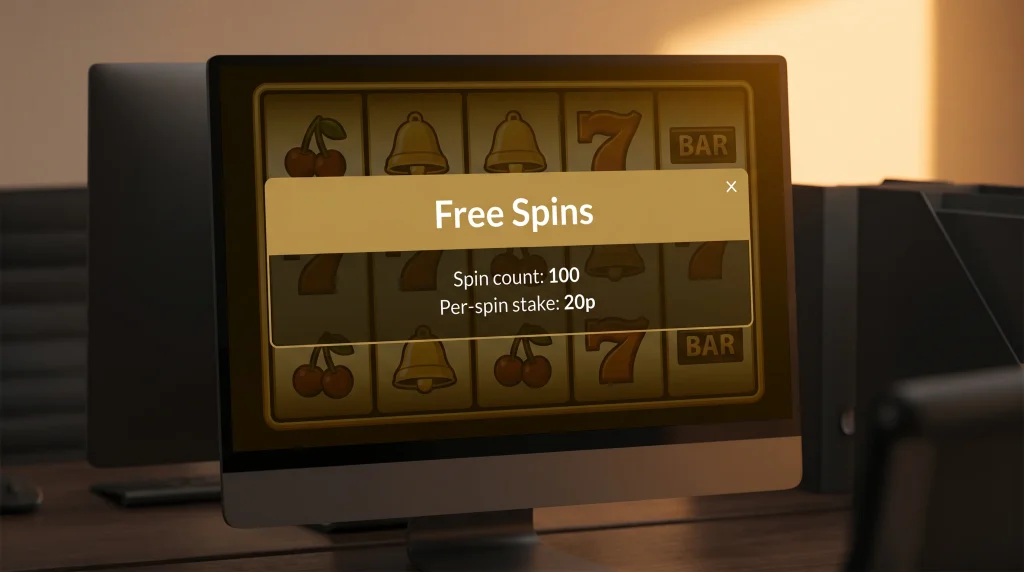
The free-spin component is the fourth lever and the most flexible one for marketing purposes. Spin counts are large, spin values are small, and the value per spin can be set as low as ten pence on a slot whose minimum stake at full bet is forty. Tied to that lever is the most overlooked clause in the entire package — whether the spin winnings are paid as cash or as further bonus credit. If spin winnings convert to bonus, they enter the wagering chain at the headline multiple, and the visible 200 spins translate to roughly £20 of additional bonus liability rather than £20 of cash equivalent. The fifth lever, the time limit, governs all four of the above by determining whether the package is mathematically completable at all. A 35x wagering requirement on a £100 bonus with a seven-day window translates to £3 500 of turnover in seven days, which in turn implies a sustained spin pace that the modal recreational player will not maintain. The package can be marketed at full value precisely because the structure ensures that a measurable share of accepted bonuses will expire incomplete.

Free Spins: Headline Counts, Spin Value, Wager Multipliers
Of all the levers operators have available, the free-spin headline is the most plastic. Spin counts are essentially free to inflate, because the cost to the operator is governed by spin value rather than spin count, and the value can be set as low as the slot’s minimum stake on the smallest configuration the studio offers. The promotional difference between “100 free spins” and “500 free spins” is, in expected-value terms, often a difference of about four pounds.
The variable that actually determines the cash value of a free-spin allocation is the per-spin stake. A 500-spin pack at 10p per spin is a £50 wagering allowance; the same 500 spins at 20p is £100, and at 40p is £200. The operator picks the per-spin number on the back-end and rarely highlights it on the front-end, which is the entire point of pricing freedom at the lower end of the spin-value range. When a free-spin offer does not display the per-spin stake clearly, you can assume it is set at the minimum available for the configured slot.
The studio mix on the spin pack is the second variable. Pragmatic Play held nine of the ten most-played slot positions in Q1 2025 with seven titles in the broader top twenty, which is why free-spin packs at non-GamStop sites are heavily skewed towards Pragmatic Play titles — the operator knows the player will recognise the games and engagement will be higher. The studio identity tells you nothing about the spin’s expected value, but it tells you something about the cohort the operator is targeting; spin packs on niche or older titles indicate a budget-driven promotion, while spin packs on currently-trending Pragmatic Play releases indicate the operator is competing for high-intent players directly.
The wagering treatment of free-spin winnings is the third and most consequential variable. The two architectures in common use are cash-conversion, where any winnings become withdrawable cash subject only to a max-cashout cap, and bonus-conversion, where winnings enter the bonus balance and become subject to the same wagering multiple as the main bonus. Cash-conversion is rare in this niche; bonus-conversion is the default. A pack labelled “100 free spins, no wagering” is therefore worth dramatically more than the larger “500 free spins, 35x wagering” headline that sits two clicks away, even though the second number is five times the first.
The honest read on free spins is to compute the expected-value floor before evaluating the headline. The formula reduces to spins multiplied by per-spin stake multiplied by slot RTP, with the result then divided by the wagering multiple if winnings convert to bonus, or held flat if they convert to cash. The number that comes out of that calculation rarely matches the marketing.
Recommended online casinos
- ChanzeBonus: Slots Welcome Bonus #1 200% up to €500 · Payout speed: 1-3 business days
- ZombillionBonus: Welcome Pack 250% up to £4000 + 200 FS · Payout speed: 1-3 business days
- NightWinBonus: £900 + 400 free spins · Payout speed: 1-3 business days
- WinBeastBonus: €5000 + 500 FS + €650 Freebet · Payout speed: 1-3 business days
- EvoSpinBonus: 125% up to €2500 + 125 Free Spins · Payout speed: 1-3 business days
- SlotoSportBonus: 500% up to £ 10 200+ 777 FS · Payout speed: 1-3 business days
- BritsinoBonus: Welcome Package – Get your £2,200 + 2,000 FS · Payout speed: 1-3 business days
- BeOnBetBonus: 100% up to €500 + 100 FS · Payout speed: 1-3 business days
- AmunbetBonus: Join now and get 450% up to 2,700 GBP + 450 FS · Payout speed: 1-3 business days
Wagering Requirements: The 10x UKGC Cap vs the 35–45x Offshore Norm
The headline difference between UKGC and offshore wagering is one ratio: 10x against 35x to 45x. The deeper difference is what the multiplier is applied to and how the clearance maths interact with the rest of the bonus terms. A UKGC 10x bonus on a £100 credit means £1 000 of turnover before withdrawal. A non-GamStop 40x bonus on the same credit applied to bonus alone means £4 000. The same 40x applied to bonus-plus-deposit on a £100 deposit plus £100 bonus means £8 000. The headline ratio of 4:1 between regimes hides an effective ratio that often runs at 8:1 once the base is accounted for.
The 19 December 2025 UKGC rule that fixed the 10x cap is worth reading literally — the cap is on the wagering multiple alone, with the rest of the bonus architecture (game weighting, max-bet, eligible-title restrictions) also tightened in the same rule package. The non-GamStop space inherited none of those tightenings. An offshore bonus at 40x can still apply 100% weighting to a narrow band of low-RTP slots, can still cap max-bet at £5 while the bonus is active, and can still exclude any title with a feature-buy or any title above a particular RTP threshold from contributing to wagering at all.
The clearance maths on a 40x bonus deserve more attention than they usually receive. If a player turns over the required £4 000 on a 96% RTP slot, the expected loss across that turnover is 4% of £4 000, which is £160. The bonus credit was £100. The expected outcome of full clearance is therefore a net loss of £60 against the deposit balance — before any variance, before any restriction tripping. The bonus is, in expected-value terms, negative for the player even if everything goes smoothly.
That outcome is not unique to offshore. It is the structural reality of any matched-deposit bonus where the wagering multiple times one minus the slot RTP exceeds the headline match percentage. UKGC’s 10x cap pulls a 100% match on a 96% RTP slot into expected-value territory of roughly break-even before variance; the offshore 40x norm pushes it deep into negative territory. The honest framing for a player evaluating a non-GamStop bonus is that the multiplier is the single most predictive number on the page, and that any multiple above approximately 25x on a 96% RTP slot library converts the offer from “matched value” to “matched marketing”.
The two-tier reading I apply to wagering is whether the multiple is theoretically clearable inside the time limit at realistic spin pace, and whether the expected value remains positive after the slot RTP is netted off. A 35x bonus on a high-RTP slot library with a thirty-day window is materially different from a 35x bonus on a low-RTP library with a seven-day window, even though the headline is identical.

Reload Bonuses, Cashback & Loyalty Mechanics
The welcome package is the marketing surface. The reload and loyalty mechanics are where the operator’s real player economics live. Almost every non-GamStop site I track runs a weekly reload offer in the 25% to 75% range, a cashback program returning between 5% and 20% of net losses across a defined period, and a tier-based loyalty system that maps spin volume to incremental percentage perks. The architecture of these mechanics matters more than the welcome package for any player intending to stay on the platform past the first month.
Reload bonuses repeat the welcome structure at smaller scale, usually with comparable wagering multiples and similar restriction layers. The variable to watch is the trigger threshold — whether the reload requires a fresh deposit above a minimum, whether it requires opt-in through a code or a button, and whether it has a per-week or per-month cap. The reload economy is most attractive where the wagering multiple is below the welcome rate and the trigger threshold is set near the modal deposit size; it is least attractive where the reload is gated behind a tier requirement that the player will not reach without sustained loss.
Cashback is the most player-friendly of the three loyalty mechanics in expected-value terms, because it pays out on realised losses rather than on theoretical turnover. A 10% weekly cashback on net losses with no wagering requirement and a reasonable cap converts the operator margin into a soft floor that bounds downside variance over the cashback window. The clause to read carefully is the calculation base — whether cashback is computed on deposit-minus-withdrawal or on a turnover-based formula, and whether bonus losses are included in the loss tally. Operators that exclude bonus-funded losses from the cashback base are reducing the effective rate substantially without changing the headline.
Loyalty tiers are the lever the operator uses to manage long-term player economics. The tier structure is almost always front-loaded, with the marginal benefit of reaching a higher tier declining rapidly past the first one or two. The market also offers a small population of operators running entirely outside the wagering-bonus model, a category I treat separately and that I discuss in detail when I cover promotions that strip out the wagering layer entirely. For players whose intended pattern is regular small play rather than occasional larger sessions, the no-wagering category often produces better realised value than any of the front-loaded packages.
Game Weighting, Max Bet Rules & Buy-Feature Restrictions
The Gambling Commission’s Market Impact Statement covering the post-stake-limit period concluded that The data suggests the caps are not leading to a lack of activity or engagement with online slots games, but that the inability to place large stakes is leading to players being less inclined to play for longer periods of time.
The same finding applies in mirror image to non-GamStop bonus terms. When the operator restricts maximum bet to £5 while the bonus is active — a near-universal clause in the niche — the design intent is identical to the regulator’s intent at UKGC sites: lengthen the time required to complete a wagering cycle, increasing the probability the bonus will not be cleared within its window. The operator and the regulator are using the same lever for opposite reasons, with the same effect on player behaviour.
Game weighting is the second restriction layer and the most opaque one. The standard table contributes 100% from low-RTP and medium-volatility slots, between 10% and 25% from high-RTP slots and certain titles flagged as “advantage games” by the operator, and 0% from blackjack, baccarat, video poker and most table games. Some operators ship a third tier of game-weighting at zero — typically Megaways titles, certain Pragmatic Play releases, and most NetEnt classics with RTPs above 97%. A player who reads the wagering multiple without reading the weighting table can find their preferred slot contributes nothing to clearance and the bonus is structurally unclearable inside the window regardless of stake or pace.
Buy-feature restrictions are the third and newest layer in the architecture. The bonus-buy mechanic, removed from UKGC sites in 2023, is widely available at non-GamStop operators — but using the feature while a bonus is active is almost always grounds for bonus forfeiture. The restriction sits in the terms, not in the cashier interface, which means a player can buy a feature without warning and trigger forfeiture without realising it until withdrawal is denied. The defensive read on any feature-buy slot while a bonus is active is to assume the buy is prohibited unless the terms explicitly permit it.

Worked Example: Effective Value of a £100 + 100 Spins Offer
The clearest way to read a bonus is to compute it. The example below uses brandless figures from a typical non-GamStop welcome package — 100% match up to £100, 100 free spins at 20p each on a generic 96% RTP Pragmatic Play slot, 40x wagering on bonus-plus-deposit, max bet £5, seven-day completion window, max cashout £500 on the bonus-funded portion.
The base credit is £100 deposit plus £100 bonus, totalling £200 in playable balance. The wagering requirement is 40x bonus-plus-deposit, which equals 40 multiplied by £200, which equals £8 000 of turnover required to clear. At an average bet of £2.50 — half the max-bet ceiling, which is a realistic pace for a recreational player on a 96% RTP slot — that turnover requires 3 200 spins. At three spins per minute, the standard pace on a non-feature spin without animation skipping, 3 200 spins is approximately 17.8 hours of active play, or roughly 2.5 hours per day across the seven-day window.
The expected-value arithmetic on those 3 200 spins is straightforward. At 4% house edge across £8 000 of turnover, the expected loss across the wagering chain is £320. The bonus credit was £100. The expected net outcome of a perfectly executed clearance is therefore a loss of £220 against the deposit balance — before any cashout cap, before any restriction-tripping, before any time-window failure. The free spins add a separate layer worth, in expectation, 100 spins multiplied by £0.20 multiplied by 96% RTP, which equals £19.20 of spin winnings on average, with that £19.20 entering the bonus balance and subject to the same 40x wagering treatment, meaning its incremental expected value contribution is roughly £4.
The high-RTP shelf is worth comparing as a counterfactual here. Running the same arithmetic on a 99% Mega Joker configuration drops the expected loss across the wagering chain from £320 to £80, but most operators exclude high-RTP slots from bonus eligibility or weight them at zero, which is why this counterfactual usually cannot be realised in practice. The headline read on the example offer is “£100 free plus 100 spins”. The arithmetic read is “an expected net loss of approximately £220 on completed wagering, with a 60% to 75% probability of failing to complete and forfeiting the bonus credit altogether”. The two reads are not in agreement.

Why “Not on GamStop” Dominates Offshore Promo Volume
The 84% promo-volume figure from Yield Sec is the single most useful number in this niche for understanding why bonus structures look the way they do. When the overwhelming majority of all illegal-operator promotional activity is concentrated on a single positioning phrase, the resulting market is one in which every operator is selling against every other operator on the same comparison axis. The headline arms race that produces £7 500 welcome packages is a direct consequence of that concentration.
The acquisition channel matters as much as the message. The dominant channels for non-GamStop bonus marketing are social platforms, search ads that survive intermittently before being delisted, affiliate review sites, and increasingly, stream overlays on unlicensed sports broadcasts. Each channel has a different cost-per-acquisition profile, and each rewards a different headline structure. Social rewards round numbers and large multipliers; search rewards specificity around payment method or licence type; affiliates reward exclusivity claims; stream overlays reward immediacy. The composite effect is a marketing surface optimised across four channels simultaneously, which is why the headline language is so consistent across operators that otherwise differ in licence, library and cashier behaviour.
The arms race has a structural ceiling, which the niche has not yet reached. As headline numbers rise, the effective gap between marketed value and realised value widens, which over time degrades the trust signal on the entire category. The current cycle is sustained by continuous acquisition of first-time players who have no historical reference for what a credible bonus looks like outside the UKGC perimeter; once that population is exhausted, the marketing economics will compress and headline numbers will stabilise. That is a multi-year horizon and not a present-tense planning constraint, but it explains why the current period is the high-water mark of headline inflation in non-GamStop promotion.
The practical implication for a UK player reading offshore bonus marketing in 2026 is that headline competition is at its loudest precisely because the underlying expected-value gap is at its widest. The credible reads on any offer in this environment are the ones based on arithmetic — the worked-example structure from the previous section, applied to whatever package is in front of you, before any decision to claim it.
Frequently Asked Questions
Why are non-GamStop slot bonus headlines often two or three times larger than UKGC offers?
The wagering cap UKGC imposed on its licensees from 19 December 2025 limits bonus wagering to 10x, while the non-GamStop norm sits in the 35x to 45x band. The wider regulatory perimeter at UKGC also constrains maximum offer sizes, game weighting and headline presentation standards. Strip both perimeters away and operators can market much larger headline numbers even when the realistic redemption value of the offer is similar or lower than a UKGC equivalent.
What is the typical wagering requirement on a non-GamStop free spins package?
The standard architecture applies the same wagering multiple to free-spin winnings as to the main bonus credit, which means a 35x or 40x multiple is typical on bonus-converted spin winnings. The rarer “no wagering” free-spin pack pays winnings as cash subject only to a max-cashout cap, which makes a smaller no-wagering pack worth more in expected-value terms than a larger pack with bonus-conversion attached.
Can a non-GamStop bonus be used on bonus-buy slots or feature-buy games?
The bonus-buy feature is widely available at non-GamStop operators after being removed from UKGC sites in 2023, but using the feature while a bonus is active is almost always grounds for bonus forfeiture. The restriction sits in the terms-and-conditions rather than in the cashier interface, so it is possible to buy a feature and trigger forfeiture without realising it until a withdrawal is denied. The defensive position is to assume the buy is prohibited under any active bonus unless the terms explicitly permit it.
How are non-GamStop slot bonuses settled when a player triggers a withdrawal mid-wager?
The standard term forfeits the bonus and any bonus-derived winnings on a mid-wager withdrawal, returning only the deposit minus any losses incurred against it. Some operators allow partial proportional release based on completed wagering percentage; this is the minority architecture and is always disclosed in the terms. The practical implication is that any decision to withdraw mid-wager should be treated as a decision to abandon the bonus entirely, not as a decision to capture a partial value.
If you want to avoid steep playthrough requirements entirely, explore our curated list of no wagering slot bonuses not on GamStop for much fairer withdrawal terms.
Always read the fine print and consult our trusted UK non-GamStop casino guide before claiming any promotional offers.
Casino Sites
Written by the editors at non Gamstop slots UK.