
Safest Non-GamStop Slot Sites and Licensing Audits
 Available in GB
Player Protection at Safest Non-GamStop Slot Sites
The word “safe” gets used promiscuously in this niche. Every operator review page calls its top picks “safe and trusted” and every promotional channel calls its featured sites “secure and reliable”, and almost none of these descriptions are grounded in any structured definition of what the words are supposed to mean. The first task of this article is to fix that — to set out, before any operator can be evaluated, what “safety” actually consists of when the player-protection layer attached to a UKGC licence is not present.
The working definition I use has five elements. Verifiable licence with active complaint-handling. Identifiable corporate ownership with a meaningful address. Segregated or demonstrably-funded player balances. A dispute-resolution path that has actually been used to resolve disputes within the past twelve months. And an operator-side withdrawal record that does not show systemic delays or denials in the public complaint record. A site that passes all five is safe in the sense that the structural protections needed to recover funds and to obtain redress are present; a site that passes three or four is operating in a grey zone where some protections exist and others do not; a site that passes none of the five is operating with no protective layer at all, regardless of what its marketing copy says.
The population to be careful with is real and identifiable. The independent evaluation of GAMSTOP estimated that approximately 8% of GamStop users continued to bet at unlicensed operators after self-excluding from the UKGC perimeter; Yield Sec’s recidivism calculation, based on a registered user base of 532 484, applied a 25% recidivism rate. The two estimates are not in agreement on magnitude, but they agree on the underlying point — a meaningful share of the GamStop population is reaching offshore operators after self-exclusion, and that population is by definition the most vulnerable subset of the player base. Any safety framework that does not start from the most vulnerable users is not a safety framework; it is a marketing framework with safety language layered over the top.
Recommended online casinos
- ChanzeBonus: Slots Welcome Bonus #1 200% up to €500 · Payout speed: 1-3 business days
- ZombillionBonus: Welcome Pack 250% up to £4000 + 200 FS · Payout speed: 1-3 business days
- NightWinBonus: £900 + 400 free spins · Payout speed: 1-3 business days
- WinBeastBonus: €5000 + 500 FS + €650 Freebet · Payout speed: 1-3 business days
- EvoSpinBonus: 125% up to €2500 + 125 Free Spins · Payout speed: 1-3 business days
- SlotoSportBonus: 500% up to £ 10 200+ 777 FS · Payout speed: 1-3 business days
- BritsinoBonus: Welcome Package – Get your £2,200 + 2,000 FS · Payout speed: 1-3 business days
- BeOnBetBonus: 100% up to €500 + 100 FS · Payout speed: 1-3 business days
- AmunbetBonus: Join now and get 450% up to 2,700 GBP + 450 FS · Payout speed: 1-3 business days
The Player-Protection Layer UK Residents Leave Behind
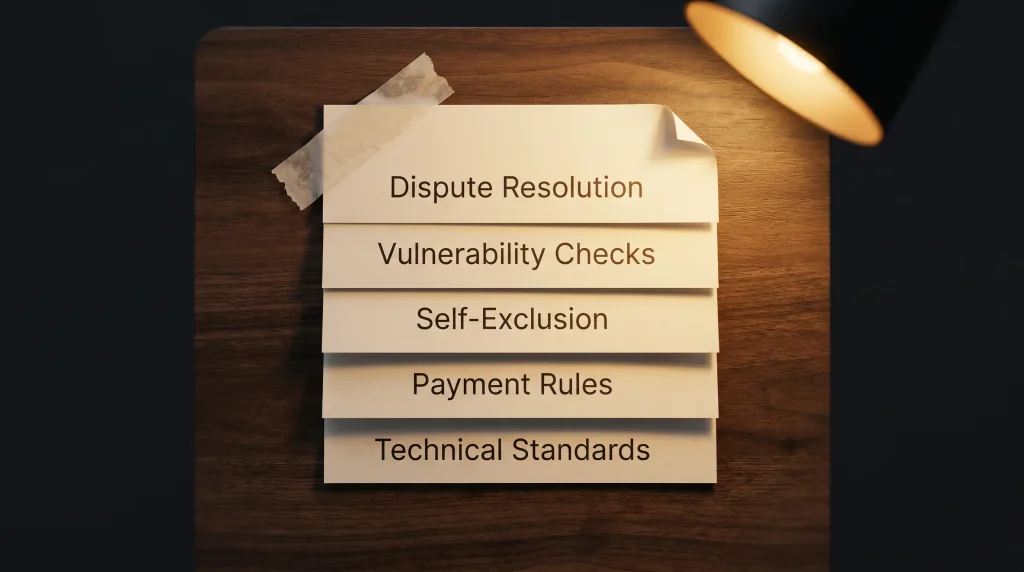
Leaving the UKGC perimeter does not just change which logo sits in the website footer. It removes a stack of player protections that have accumulated across two decades of regulatory development, and the stack is much taller than most players intuitively realise. Listing what is left behind, in order of practical consequence, is the necessary first step before evaluating what replaces it offshore.
The first layer is dispute resolution through an approved Alternative Dispute Resolution body. UKGC licensees are required to participate in an ADR scheme that handles player complaints independently of the operator and that produces decisions the operator is contractually obliged to honour. The ADR layer is what allows a UK player at a licensed site to escalate beyond the operator’s internal complaints function with a structured outcome at the end. No equivalent layer exists by default at offshore licences; some jurisdictions have something resembling it, and the rest do not.
The second layer is the financial vulnerability framework. UKGC-licensed operators are required to run financial vulnerability checks at the £150 net deposit threshold within 30 days, lowered from £500 in February 2025, and Financial Risk Assessments in the regulator’s pilot extend that framework further. The Ian Angus speech at the 2026 Clarion Payment Providers Summit summarised the FRA architecture as one in which 97% of checks complete frictionlessly and less than 3% of active accounts will trigger any sort of financial check at all. The protection that this framework offers — early detection of harm patterns before they escalate — is entirely absent at offshore operators, who run AML-focused source-of-funds checks at much higher thresholds and only in response to specific transaction triggers.
The third layer is the GamStop scheme itself, which operates as a cross-operator self-exclusion register binding every UKGC licensee. The independent evaluation of GamStop found that 75% of registered users no longer gambled online during the exclusion period — the protection works, in the population it can reach, and that population is bound to the UKGC perimeter. Outside the perimeter, no equivalent cross-operator register exists. A self-excluded user who registers at a non-GamStop site is doing so on a per-operator basis, with each new operator a fresh registration and a fresh exposure.
The fourth layer is the regulated payments framework. UKGC’s ban on credit card use for gambling, in force since April 2020, removed one of the major vectors of debt-funded play; the deposit and withdrawal automation standards that produce the 96.3% automated processing benchmark create predictability around cashier behaviour. Neither structure carries across to offshore operators. The fifth layer is the technical-standards regime — RTP certification, RNG audit, advertising restrictions on bonus presentation, max-stake caps at £5 across the player population and £2 for the 18-to-24 cohort. The technical-standards layer is the one that most directly shapes what a player experiences when they actually play; its absence at offshore sites is the structural reason the non-GamStop space looks and behaves so differently from a UKGC slot site even when the underlying games are visually identical.
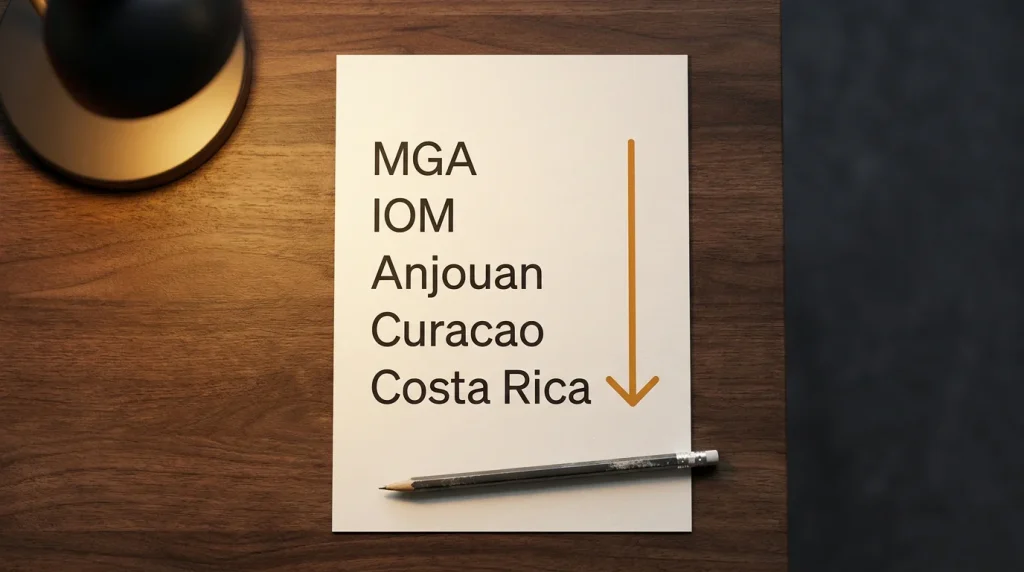
Licence Strength Ranking: MGA, IOM, Anjouan, Curaçao, Costa Rica
Not all offshore licences are equivalent, and the difference between the strongest and the weakest is one of the most significant variables in any safety assessment. The five jurisdictions that account for the overwhelming majority of non-GamStop operators serving UK players are Malta, the Isle of Man, Anjouan, Curaçao, and Costa Rica, and they sort cleanly along measurable dimensions: regulator activity, complaints-handling record, capital requirements, technical-standards enforcement, and verifiability of the licensee against the public register.
Malta’s MGA licence sits at the top of the offshore stack on every one of those dimensions. The regulator runs an active enforcement function, publishes decisions, maintains a verifiable register, imposes substantive capital and operational standards, and handles player complaints through a documented process. An MGA operator behaves much more like a UKGC operator than like any of the other jurisdictions on this list, including in ways that may be counter to a player’s preferences — tighter KYC at lower thresholds, narrower bonus terms, more conservative game-weighting tables. The trade-off is real, but the protection layer is real with it.
The Isle of Man Gambling Supervision Commission, the IOM regulator, sits in the same tier as MGA on most dimensions and exceeds it on some. The licence is more expensive and harder to obtain, the operator population is correspondingly smaller, and the technical standards run closer to UKGC’s than any other offshore jurisdiction. The presence of an IOM licence is one of the strongest positive signals an offshore operator can carry; it is also relatively rare in the population that markets actively to UK players.
Anjouan, issued by the Union of Comoros, occupies the middle ground. The licence is verifiable through the issuer’s register, the technical standards are documented, and complaints handling exists on paper. The enforcement record is shorter than MGA’s and the volume of decided cases smaller, but the licence reflects a deliberate choice by the operator to pay for documented oversight rather than dispense with it altogether. Anjouan has grown in operator share through 2025 and 2026 as the post-LOK Curaçao transition pushed some operators to seek alternatives.
Curaçao is the jurisdiction undergoing the most significant structural change. The new Landsverordening op de Kansspelen — the LOK — came into force on 24 December 2024, replacing the 1993 Offshore Games Ordinance; every remaining sub-licence under the old master-licensor model was annulled on 31 January 2025, and the final master-licence expired on the same day. The new B2C licence under LOK costs roughly €47 000 per year, B2B costs around €24 000, and mandatory local-presence requirements phase in across 2028 and 2029. The structural effect is to raise the floor cost of being a legitimate Curaçao operator substantially above the pre-LOK regime. A site displaying a Curaçao seal in 2026 either holds a direct B2C licence issued by the Curaçao Gaming Authority under LOK, or it is operating without authorisation in its declared jurisdiction. I cover the licence-specific operator picture in more depth when I look at the jurisdiction that now operates under the post-LOK regime. One UK-specific caveat is worth noting at the licence level — Curaçao’s own statutes prohibit the acceptance of players from the United Kingdom, but visible enforcement of that clause has been effectively absent through to early 2026; the prohibition exists in law and is ignored in practice by both regulator and operators.
Costa Rica sits at the bottom of the offshore stack and is a registry rather than a regulator. The “licence” is a corporate registration; there are no gambling-specific technical standards, no complaints function, no enforcement capacity. Operators whose only authorisation is Costa Rican incorporation are operating with no regulatory layer at all in any meaningful sense, and the presence of Costa Rica as the sole authorisation on a non-GamStop site should be read as a complete absence of regulated oversight regardless of what the marketing copy claims.
Where a Player Can Actually File a Dispute Offshore
The most useful clarification of the regulator’s view of the broader offshore market came at ICE Barcelona 2026, when UK Gambling Commission Executive Director Tim Miller observed of the platforms hosting illegal gambling advertising that It could leave you with the impression they are quite happy to turn a blind eye and continue taking money from criminals and scammers until someone shouts about it.
The framing is harsh; the underlying observation is structurally true at the dispute-resolution level. A UK player at a non-GamStop site who has a complaint — a stalled withdrawal, a denied bonus claim, an account closure with funds still credited — is operating in a landscape where the dispute path is shorter, slower, and less reliable than the path inside the UKGC perimeter, and the available recourse depends entirely on which licence the operator holds.
The first dispute path is always the operator’s internal complaints function. Every reputable offshore operator runs one; the quality varies enormously. At the upper tiers the response time is measured in hours, the case worker is identified, the operator’s terms-and-conditions reference is cited in the response, and a substantive answer arrives within seven days. At the lower tiers the response is automated, generic, and arrives if at all. The internal path is the first step regardless, because every external dispute body will require evidence that the internal path has been exhausted before accepting a case.
The second path is the regulator. At MGA, the Player Support Unit accepts formal complaints once internal channels have been exhausted, runs an investigation, and issues decisions that the operator is obliged to honour as a licence condition. The process takes weeks to months but produces enforceable outcomes. At IOM the Gambling Supervision Commission runs an equivalent function. At Curaçao, the post-LOK regime is building out its complaints infrastructure, but the operational track record is short and the case volume small. At Anjouan, the issuer accepts written complaints and will engage with the operator, with outcomes that are documented but not enforceable in the same sense as at MGA. At Costa Rica, no regulatory complaints function exists at all.
The third path is an independent Alternative Dispute Resolution body, where the operator participates voluntarily. A small subset of non-GamStop operators submit to ADR through eCOGRA, IBAS or comparable bodies; the participation is voluntary but binding once entered, and the outcome carries weight in the offshore complaints ecosystem. The presence of an ADR membership on the operator’s footer — verifiable against the ADR body’s public register — is one of the stronger positive signals an offshore operator can carry, because participation requires the operator to accept binding third-party decisions on disputed cases.
The fourth path is judicial. A UK resident can in principle pursue an offshore operator through the courts of the operator’s jurisdiction; in practice this is slow, expensive, and rarely worth the cost on a typical dispute size. The fifth path — chargeback through the original payment method — is the one most players actually try, and it works only if the deposit was made through a card or wallet that supports chargeback; crypto deposits have no chargeback equivalent. The honest framing on dispute resolution offshore is that the path exists, that it is slower and less reliable than the UKGC path, and that the operator’s licence jurisdiction is the single most predictive variable for whether the dispute will resolve at all.

AML Reality: Source-of-Funds Checks at Non-GamStop Sites
Anti-money-laundering checks at non-GamStop operators are real, but they run on different triggers and at different thresholds than at UKGC sites. The most important difference for the player is that AML checks at offshore operators are almost always triggered at withdrawal rather than at deposit, which means the first time a player encounters source-of-funds questioning is usually when they are trying to cash out winnings rather than when they are trying to put money in.
The UKGC reference frame is useful here. Financial vulnerability checks at UKGC sites trigger at the £150 net deposit threshold within 30 days, lowered from the original £500 threshold in February 2025. The check is automated, draws on credit-reference data without affecting the player’s credit file, and runs in the background of the deposit flow. The threshold and the architecture are both significantly different from the offshore equivalent — non-GamStop operators run their own AML procedures rather than relying on a regulator-defined check, and the thresholds for source-of-funds requests typically sit at withdrawal amounts in the £2 000 to £5 000 range, or at cumulative balance levels above £10 000.
The documentary requirements when an offshore AML check fires are usually heavier than the UKGC equivalent. The standard request packet includes proof of identity, proof of address, source-of-funds documentation for the deposited amounts, and source-of-wealth documentation for any cumulative balance above the operator’s secondary threshold. The documentation has to be acceptable to the operator’s compliance team, the standard is the operator’s internal standard rather than a regulatory standard, and the resolution window can stretch into weeks. The withdrawal sits pending until the compliance review concludes.
The variability between operators on AML behaviour is wide. At the upper tiers of the niche, AML is run as a defensive operational function — the operator wants to satisfy its own correspondent banking relationships and its licensing jurisdiction’s AML standards, and the procedure is professional but heavy. At the lower tiers, AML is used asymmetrically — light at deposit, heavy at withdrawal, with the practical effect of slowing or blocking cashouts that the operator would prefer not to honour. The asymmetry is documented in the public complaints record across multiple operators and is one of the more consistent patterns in the offshore landscape.
The defensive position for any player approaching a non-GamStop site is to assume that documentation will be required at withdrawal, to prepare the standard packet in advance, and to make the first withdrawal at a modest size to test the operator’s AML behaviour before committing larger balances. Operators that process the first modest withdrawal cleanly are usually consistent on subsequent ones; operators that introduce friction on the first one usually escalate that friction on the second.

Self-Exclusion Outside GamStop: Practical Routes
The GAMSTOP scheme reached 562 000 registered users by the end of 2025 and is the only cross-operator self-exclusion register that binds the entire UKGC-licensed population. Outside that perimeter, no equivalent cross-operator scheme exists for non-GamStop operators, and the practical routes available to a player seeking exclusion are individually weaker and operationally fragmented. The independent evaluation of GAMSTOP found that 75% of registered users no longer gambled online during their exclusion period; the equivalent figure for any individual self-exclusion measure at an offshore operator is not measured and would almost certainly be lower in any measurement window, simply because no single registration binds across operators.
The first practical route is per-operator self-exclusion. Most reputable non-GamStop operators offer some form of account closure or exclusion option within their account settings; the quality varies from a functional cooling-off period with documented re-activation procedures down to a “close account” button with no specific exclusion period attached. The route works for the specific operator only, and a player using it remains free to register at any other operator the next day. The protection is real for the operator in question and structurally insufficient for a user with multiple-operator exposure.
The second route is software-level blocking. Tools such as Gamban, BetBlocker, and Net Nanny block access to gambling sites at the device level, and the better tools maintain lists that include non-GamStop operators alongside UKGC-licensed ones. The block is enforced at the user’s device rather than at the operator, which means it works regardless of whether the operator participates in any exclusion scheme. The limitation is that device-level blocks can be circumvented by switching devices, and the tools therefore work best when installed across all of the user’s devices and combined with payment-level controls.
The third route is payment-level blocking. UK retail banks now offer gambling transaction blocks on personal accounts, with the block applying to merchant codes associated with gambling. The block works for card payments to identified gambling merchants and does not catch payments routed through crypto on-ramps that classify as exchange transactions; the protection is partial in the offshore context but meaningful as a complementary layer.
The fourth and most important route is direct support. The National Gambling Helpline operates around the clock on 0808 8020 133 and provides confidential support, advice, and referral to treatment services for anyone experiencing gambling-related harm. The helpline is independent of the UKGC and accessible regardless of which operators a person has used. For a player whose primary exposure is to offshore sites, the helpline is the single most useful entry point into the support ecosystem, because it bypasses the operator-level fragmentation that limits every other route.
A Six-Point Due-Diligence Process Before Depositing
The defensive framework I use before any first deposit at a non-GamStop site reduces to six checks, in order. The checks take about twenty minutes total, they require no specialist tools, and they catch the majority of operator-level problems that would otherwise emerge only at withdrawal. The Yield Sec population estimate of around 700 operators and 1 600 affiliates actively targeting UK players, with the earlier 2025 estimate at 531 operators and 1 100 affiliates, gives a sense of why this filter matters — the population is large enough that the marginal cost of running the checks is small compared to the cost of skipping them and depositing into a third-tier operator.
Check one is licence verification. Click the licence logo on the operator’s footer. The link should go to the issuer’s public register and the register entry should name the same company that appears on the operator’s footer. Any divergence — broken link, register entry naming a different company, register entry listing the licence as “withdrawn” or “in suspension” — is a stop signal. The licence verification is the single most informative test in the sequence; an operator that fails it has failed the basic transparency test that everything else depends on.
Check two is corporate structure. The operator’s terms-and-conditions or “About” page should name a parent company, an address, and ideally a contact registration. Search for the parent company in the corporate registry of the named jurisdiction. The corporate trail should reach an identifiable entity; if it terminates at a shell with no beneficial owner identifiable, the operator has chosen opacity over accountability.
Check three is the public complaints record. Run a search for the operator’s name combined with “complaint” or “withdrawal” or “dispute” on independent forums and review aggregators that are not part of the operator’s affiliate network. The pattern matters more than the individual reviews; a small number of complaints alongside a large pattern of positive feedback is normal, while a consistent cluster of unresolved-withdrawal complaints is not.
Check four is the cashier walkthrough. Register an account, complete identity verification, and inspect the cashier without depositing. The deposit and withdrawal menus should be symmetrical in available methods; minimum withdrawal limits should be no higher than minimum deposit limits; the withdrawal policy should specify the processing window and KYC trigger thresholds clearly. Cashier asymmetry — deposits in seconds, withdrawals through multiple “verification” stages that did not exist at registration — is a stop signal.
Check five is the bonus terms read. Open the welcome bonus terms-and-conditions and read for the wagering multiple, the wagering base, the game-weighting table, the max-bet clause, the eligible-title list and the time window. Terms that internally contradict — for example a 35x wagering requirement on a seven-day window with a £5 max-bet on a slot library where the realistic spin pace makes the requirement mathematically unclearable inside the window — are not accidents.
Check six is the modest first deposit. The first deposit should be at a small size, followed by a small withdrawal, followed by an inspection of the round-trip behaviour. Operators that process the first modest round-trip cleanly are usually consistent on subsequent ones; operators that introduce friction on the first one usually escalate that friction on the second. The first round-trip is the single most informative behavioural data point you can collect, and it costs you only a small first-withdrawal sample to measure.

Operator-Level Warning Signs Players Underestimate
The bluntest characterisation of the offshore operator population I have seen from any regulator came in a coroner’s court hearing where Tim Miller described the operators behind the “Not on GamStop” branding as Sophisticated international criminal networks
. Even allowing for the institutional vocabulary, the warning is grounded in observable behaviour patterns, and the warning signs that follow are the behavioural expressions of the underlying structure.
The first warning sign is promotional concentration. Operators that spend disproportionately on UK-facing promotional channels are doing so because their long-term player economics require continuous acquisition pressure, and the same Yield Sec and Campaign for Fairer Gambling report that mapped the offshore ecosystem found that 89% of views of illegal sports streams in the UK contained advertising for illegal gambling alongside embedded malware, spyware and keyloggers. The promotional channel mix tells you something about the operator that nominally has nothing to do with the operator’s site quality — the same operator appearing across high-risk promotional surfaces is downstream of the same acquisition logic.
The second warning sign is terms versioning. A reputable operator dates its terms-and-conditions and preserves prior versions; an operator that silently edits its terms in place and times the edits to coincide with active player disputes is doing so because the architecture rewards it. The third is licence churn — operators that change their licensing jurisdiction without a corresponding corporate change are signalling that they are seeking the path of least regulatory resistance rather than the path of strongest player protection.
The fourth warning sign is review-pattern artefacts. A cluster of identical five-star posts dated within the same fortnight on a single review aggregator, combined with a thin set of negative reviews on independent forums describing the same complaint pattern, is the typical signature of a paid reputation operation. The fifth is silent ownership — operators routing through offshore shells without naming a beneficial owner have made a deliberate choice about accountability that no marketing language can offset. These signals matter not because they individually predict misconduct but because they remove the recourse channels described earlier. An operator with opaque ownership cannot be served effective notice; one whose terms shift mid-tenure cannot be held to a frozen contract. The warning signs are the structural absence of mechanisms that make every other safety layer enforceable.

Frequently Asked Questions
Can a UK player recover funds from a non-GamStop slot site that refuses to pay out?
Recovery paths exist but are weaker and slower than the UKGC equivalent, and depend on the operator"s licence jurisdiction. At MGA-licensed operators the regulator"s Player Support Unit accepts formal complaints once internal channels are exhausted and issues binding decisions; at Isle of Man the Gambling Supervision Commission runs an equivalent function; at Curaçao the post-LOK regime is building its complaints infrastructure but the track record is short; at Anjouan complaints are accepted but outcomes are not enforceable in the same sense; at Costa Rica no regulatory complaints function exists. Card chargebacks may work if the deposit went through a card; crypto deposits have no chargeback equivalent.
Which non-UKGC licence offers the strongest dispute-resolution path for slot players?
Malta"s MGA licence and the Isle of Man Gambling Supervision Commission both run active complaints functions with documented outcomes that operators are obliged to honour as licence conditions. The two jurisdictions sit at the top of the offshore stack on dispute resolution and behave most similarly to the UKGC perimeter in this respect. Anjouan accepts complaints with documented but less enforceable outcomes; Curaçao under the new LOK regime is building out its complaints capacity; Costa Rica is a registry rather than a regulator and offers no complaints function.
Do non-GamStop slot sites run any meaningful AML checks before allowing withdrawals?
Yes, but the triggers and thresholds differ substantially from UKGC. AML checks at offshore operators are almost always triggered at withdrawal rather than at deposit, with source-of-funds requests typically firing at withdrawal amounts in the £2 000 to £5 000 range or at cumulative balance levels above £10 000. The documentary requirements when a check fires tend to be heavier than UKGC equivalents, the standard is the operator"s internal standard rather than a regulatory one, and the resolution window can stretch into weeks. At the upper tiers AML is professional and defensive; at the lower tiers it is used asymmetrically to slow withdrawals the operator prefers not to honour.
Are there self-exclusion tools that work across multiple non-GamStop slot sites at once?
No cross-operator self-exclusion register exists outside the UKGC perimeter. GAMSTOP, which reached 562 000 registered users by the end of 2025, binds only UKGC-licensed operators. The practical alternatives outside that perimeter are per-operator self-exclusion at each site individually, software-level blocking through tools like Gamban or BetBlocker installed across the user"s devices, and payment-level gambling blocks on retail bank accounts. The National Gambling Helpline on 0808 8020 133 provides independent support that bypasses the operator-level fragmentation.
Bonuses
Published by the non Gamstop slots UK team.