
Penny Slots Machines UK: Stakes and Payouts
 Available in GB
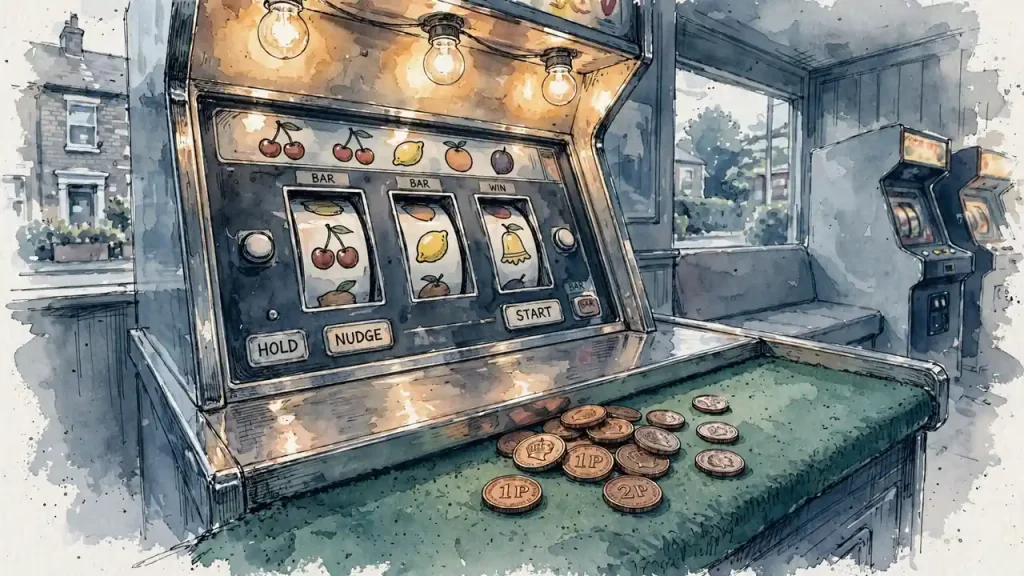
See how line values and paylines affect the total stake, and what to consider when choosing a game or setting play limits.
What Makes a Slot a Penny Slot?
A penny slot is defined by the smallest amount you can stake on a spin, not by the largest amount the game allows. A practical definition is a game whose minimum spin cost is 20p or less. The label does not mean every spin costs a penny: the total depends on the stake selected and on how the game structures its lines.
To work out the cost of a spin, look at two parts: the amount wagered on each line and the number of paylines included in the stake. If a game charges 1p per line and the selected stake covers 20 paylines, the spin costs 20p. A different line value or a different number of active lines changes the total. The word “penny” therefore describes a low entry point, not a fixed price for every spin.
Some games let you choose a total stake directly; others show the cost per line and let you adjust the lines or line value. In either case, the figure that matters is the total amount committed to one spin. A displayed 1p line value is not necessarily a 1p spin: multiply it by the number of lines included. If the game has other stake components, include those too when reading its total.
This distinction also explains why two games described as penny slots can have different minimum costs. One may reach a low total through a small line value, while another may have fewer lines in its minimum configuration. The relevant test is the least amount accepted for a complete spin. Under the practical definition, that amount must be no more than 20p.
The name “penny slot machine” can suggest a physical machine with a coin denomination, but the term is also used for online games. In either setting, the useful comparison is the minimum playable spin cost. A coin or line value on its own does not establish what a full spin costs, and the label alone does not tell you the highest available stake.
Slots: UK Online Casino Games and Providers
For a quick calculation, identify the cost assigned to each line, then count how many lines the selected stake covers. Multiply those figures to obtain the line-based total for the spin. For instance, the 20-line game at 1p per line comes to 20p. That is a calculation of the stake, not a prediction of what the spin will return.
When comparing descriptions, keep minimum cost separate from maximum bet. A game can qualify as a penny slot because its entry stake is low even if it offers higher stake settings as well. The term does not set a universal maximum. If you want to know the largest permitted stake, you need the game’s own stake controls or information; the penny-slot label cannot supply that figure.
There is no legal floor that requires an online slot stake to be above a particular amount in the UK. That does not mean every game accepts any tiny stake: each game has its own settings and minimum spin cost. For this reason, treat “penny slot” as a practical description based on a low minimum, rather than as a promise that every spin can be placed for one penny.
Fruit Machine Slots UK: How Online Games Work · Best Online Craps Casinos in the UK: How to Choose
A useful rule is to read the complete spin cost before deciding whether a game fits your budget. Check the line value, the number of lines included, and any other component that contributes to the displayed total. That gives you a precise answer to how much a spin costs and avoids mistaking a small per-line figure for the price of the whole play.
How Penny Slots Work: Stakes, RTP and Random Outcomes
A penny slot’s low stake changes how much money is exposed on each spin; it does not change the process that selects the outcome. Each spin is determined by a random number generator (RNG), a system tested and certified by an approved laboratory. The RNG produces values used by the game to determine the result. The visible reels then show the symbols associated with that result.
Randomness applies to each spin independently. A previous win or loss does not make a particular outcome due, and changing the stake does not make the RNG favour a different result. The stake determines the amount wagered, while the game’s programmed rules and RNG determine what happens on the spin. This distinction is central to understanding penny slots online: a small wager affects the scale of a possible return or loss, not the odds built into the game.
Spin Calculation
Example: 1p × 20 lines = 20p per spin.
What RTP measures
Return to Player (RTP) is the proportion of all money wagered that a slot is designed to return across its lifetime. It is a long-run statistical measure, not a forecast of what you will receive during a short session. A stated RTP does not mean that the game will return that exact proportion of your individual spending, or that each set of spins will balance wins and losses to match it.
The word “lifetime” matters. RTP describes results across an extremely large number of plays, not a schedule that distributes a set amount back to each player. Random outcomes can produce substantial variation over a limited number of spins. You might receive less than the RTP figure suggests, more than it suggests, or nothing in a particular stretch. None of those short-term results changes the game’s stated long-run measure.
RTP is set by the game developer and does not change when you lower or raise your stake. If a penny slot has a particular RTP, staking less does not improve that percentage. It also does not reduce the game’s built-in advantage over time. The same relationship applies at higher stakes: the percentage remains fixed even though the cash value of each wager and any resulting return changes.
How the house edge relates to your stake
The house edge is the portion of wagered money a game is designed to retain over the long run. It is the counterpart to RTP: a game with a given RTP has a corresponding house edge, expressed as the share not returned. At penny stakes, the house edge is identical to the house edge at any other stake.
Classic Slots Online UK: Reels, Lines and Play
This means a smaller wager is not a method for improving the underlying maths. It reduces the amount put at risk on each spin, so the cash effect of a result is smaller. But the relative relationship between wagers and long-run returns is unchanged. If the game’s RTP and house edge remain constant, a low stake changes the scale of the amounts, not the proportions.
For instance, lowering a stake does not turn a game with an unfavourable house edge into a fair game. Nor does increasing the stake alter the RTP to compensate for the larger amount. A player can use a smaller stake to make each individual spin cost less, but should not interpret that as a better chance of winning or a more generous version of the same slot.
Reading short runs without mistaking them for a pattern
Because the RNG determines outcomes randomly, a sequence of spins can contain clusters of wins, losses or empty results. Such a sequence does not demonstrate that the game has changed its settings. A win does not make a loss more likely on the next spin, and a run of losses does not compel the slot to pay soon. Treating recent results as a signal about the next spin confuses observed history with the mechanism that selects each new outcome.
This also explains why two players can see different results while playing the same game at the same stake. Their spins are separate random outcomes. One player’s result does not set or predict the other player’s result, and neither player’s short session can establish the slot’s true long-term return.
Core Concept
One does not change the other: the RNG determines outcomes, while the stake determines the scale of results.
When assessing penny slots for UK players, keep three ideas separate: the RNG determines each outcome, RTP describes the game’s long-run return proportion, and the stake sets the amount wagered on a spin. They interact in the financial result, but one does not rewrite the others. A lower stake makes the cash movements smaller while leaving the RNG process, RTP and house edge unchanged.
Recommended online casinos
- ChanzeBonus: Slots Welcome Bonus #1 200% up to €500 · Payout speed: 1-3 business days
- ZombillionBonus: Welcome Pack 250% up to £4000 + 200 FS · Payout speed: 1-3 business days
- NightWinBonus: £900 + 400 free spins · Payout speed: 1-3 business days
- WinBeastBonus: €5000 + 500 FS + €650 Freebet · Payout speed: 1-3 business days
- EvoSpinBonus: 125% up to €2500 + 125 Free Spins · Payout speed: 1-3 business days
- SlotoSportBonus: 500% up to £ 10 200+ 777 FS · Payout speed: 1-3 business days
- BritsinoBonus: Welcome Package – Get your £2,200 + 2,000 FS · Payout speed: 1-3 business days
- BeOnBetBonus: 100% up to €500 + 100 FS · Payout speed: 1-3 business days
- AmunbetBonus: Join now and get 450% up to 2,700 GBP + 450 FS · Payout speed: 1-3 business days
Finding Penny-Stake Games in an Online Casino
A lobby label such as “penny slots” is not enough to tell you what a game costs. The useful information is attached to each individual game: its minimum stake, maximum stake and Return to Player (RTP). UKGC rules require operators to make RTP information available, and UK-licensed operators must show these details for every game in their lobby. Read the figures on the game’s information panel rather than relying on a category name, thumbnail or promotional description.
Start with the minimum stake
To identify a penny slot, look for the lowest playable stake shown in the game details. A practical definition is a minimum spin cost of 20p or less. This is a classification based on the available starting stake; it does not mean every spin costs a penny, or that the game’s features are priced at that minimum.
Check what the displayed minimum describes. Some games present a total stake for a spin, while others show a cost per line or another stake setting. If the panel gives a per-line amount, the number of active paylines matters: the total cost is built from the line cost multiplied by the number of lines played. A game showing 1p per line across 20 paylines, for instance, costs 20p for that spin. The smallest number on the screen is not necessarily the full spin cost.
Amatic Online Casinos in the UK: Games and Access
If the lobby does not make the basis of the minimum clear, open the game information or rules before classifying it. Look for wording that identifies whether the figure applies to a line, a credit, or the complete spin. If that still leaves the total ambiguous, the display is not enough to establish that the game qualifies as a penny slot.
A “1p” label can therefore describe one component of the stake rather than the amount deducted for a full spin. Conversely, a game may qualify even if its minimum is expressed as a total stake above one penny, provided that the full minimum spin cost is within the practical threshold. Compare like with like: total spin cost against total spin cost.
Use the maximum stake as a separate check
The maximum stake answers a different question from the minimum. It tells you the highest stake available within the game, not the price of its least expensive spin. A game can offer a low entry stake while also allowing substantially higher settings, so the maximum helps you understand the range represented by the same title.
Do not use the maximum to decide whether a game is a penny slot. Apply the minimum full-spin cost for that classification, then read the maximum separately to see how far the available stake settings extend. If the lobby’s summary omits either figure, open the individual game listing or its information panel; a category filter alone cannot substitute for the published stake details.
Maximum Stake
The maximum stake is the highest bet available in a game, not the game’s return potential.
The maximum is also not a prediction of what a spin will return. It is a setting in the game’s stake range. Keeping stake information separate from payout information prevents a large maximum from being mistaken for a large expected return, and prevents a low minimum from being treated as evidence that the game is more generous.
Read RTP as a distinct game detail
RTP is a theoretical percentage describing the share of wagered money a game is designed to return over its lifetime. It is not a promise about what an individual player will receive, and it does not tell you what a particular spin will pay. When comparing listings, note the RTP shown for the version available to you and read it alongside the minimum and maximum stake, not as a replacement for either.
The figure can help you compare published game information, but it cannot identify a penny slot on its own. A game with a high displayed RTP may have a minimum stake above the penny-slot threshold; a game that meets the threshold may show a different RTP. Treat these as separate properties: the minimum establishes whether the game fits the stake category, while RTP describes its theoretical long-run return.
If the RTP is not visible in the lobby summary, check the game’s details or rules. UKGC requirements make RTP information available to players, but a short tile may not show every specification at once. The relevant figure is the one associated with the game version you can open, not a number copied from an unrelated description or another version of the title.
Compare listings by the same measures
A simple comparison keeps the three figures in separate columns:
| Detail | What it tells you |
|---|---|
| Minimum stake | Whether the lowest complete spin cost meets the penny-slot threshold |
| Maximum stake | The upper end of the game’s available stake range |
| RTP | The game’s theoretical return over its lifetime |
This makes it easier to compare penny casino slots without mistaking a low minimum for a better return. It also helps when a lobby groups games under broad labels such as “low stakes”: the label may include games whose complete minimum spin cost does not meet the practical definition.
There is no reliable way to produce a universal list of penny slots from a label alone. Lobby categories and displays can vary, while each game’s own minimum, maximum and RTP are the information that determine what the listing tells you. A title belongs in your comparison only after you have checked its full minimum spin cost. If you are considering how much you could win, neither the penny-slot label nor the maximum stake answers that by itself; RTP is a long-run measure, not a forecast for your balance.
Before treating a listing as an offer from a UK-licensed operator, verify the operator through the Gambling Commission’s public register. The register identifies the business holding the licence, which may not have the same name as the consumer-facing casino. Matching the operator’s legal name to its entry helps distinguish the licence holder from a game provider or a similarly named brand. Then return to the game details: the register concerns the operator, while the minimum stake, maximum stake and RTP concern the individual game.
Verifying Operators
Before playing for real money, verify that the operator is listed on the Gambling Commission’s public register.
For a quick screen, first confirm the full minimum spin cost, then record the maximum stake and RTP shown for that game. If any of those details is unclear or missing from the summary, consult the game’s information rather than inferring it from the category or artwork. That approach lets you identify which listings meet a penny-stake definition while keeping stake range and theoretical return distinct.
Playing Online Penny Slots for Real Money in the UK
Moving from a free-play version to a real-money game changes the consequence of each spin: the stake comes from your cash balance, and any winnings are real funds subject to the operator’s rules. The game may look the same, but free credits cannot be withdrawn or treated as money you have won. Before you start, check that you are using a UK-licensed operator and understand how its account and payment controls work.
For real-money play, eligibility and identity checks come before gambling. Remote gambling operators serving Great Britain must establish who you are before you can gamble. You may therefore be asked to provide information or documents during registration or verification. This is a regulatory requirement, not an optional step that can be avoided by choosing a low stake. Online gambling is legal in the UK for adults aged 18 and over when the operator holds a UK Gambling Commission licence.
The stake cap depends on age
The maximum stake for an online slot is set per game cycle, and the permitted amount depends on your age. If you are aged 18 to 24, the cap is £2 per cycle. If you are 25 or over, it is £5 per cycle. These limits apply to real-money online slots; they are not recommended stakes or targets. A penny slot’s low minimum does not exempt it from the applicable cap.
Amatic Games at UK Online Casinos: What to Know
The stake limit also does not mean that every game lets you choose any amount below it. Each game has its own permitted stake range, which you can check in the game information and staking controls. If the minimum stake is higher than you intended to spend, that game is not a suitable penny-stake choice for your budget, even if its title or visual design suggests otherwise. If a selected stake is above the limit that applies to you, reduce it or choose a different game.
There is no statutory minimum
UK law does not set a minimum stake for online slots. That means there is no single legal floor that every operator must apply. The minimum you can wager is determined by the options available for the particular game and the operator’s platform. One penny may be available on one game, while another may require a higher minimum. “Penny slot” describes a low-stake option, not a promise that every spin will cost exactly one penny.
Use the stated minimum stake rather than relying on labels or promotional wording. A game may offer a low line value but require multiple lines or other stake settings that raise the total cost of a spin. The amount shown as the total stake is the useful figure when deciding whether a real-money session fits your limit. If the game does not make that total clear before the spin, do not proceed until you can confirm it.
Age Limits
Attention Your maximum allowed stake per cycle depends on your age: £2 for ages 18–24, and £5 for ages 25 and over.
Deposits and stakes are separate decisions. Depositing money places funds in your casino account; it does not commit you to wagering the full balance. Set the amount you are prepared to spend before you play, and treat each stake as money that can be lost. A low per-spin cost can make it easier to keep playing for longer, so a small stake should not be mistaken for a guarantee that your overall spend will stay small.
On mobile or desktop, the basic checks are the same: confirm that the operator holds the relevant UK licence, complete any required identity checks, read the game’s minimum and maximum stake, and verify the total stake before each spin. The available real-money penny slots depend on the games and stake settings the operator offers, not on a separate legal category called “penny slots.” If the lowest available stake is outside your budget, choose another game or do not play for real money.
These conditions apply whether you are looking for a new release or a familiar online slot. A game’s age does not change the stake cap, and a low minimum does not change the identity requirement. The practical difference between free play and real-money play is that your decisions now affect your funds. Check the stake shown on screen before committing to a spin, and stop if the amount or the applicable limit is unclear.
Amatic Games at UK Casinos: How Access Works
Choosing a Game and Trying It in Free Play
Choosing a penny slot is easier when you treat the game as a set of features to inspect, rather than searching for a universally “best” option. Different games can present different layouts, controls, symbols and bonus features. A preference for one style does not tell you whether its rules are clear or whether its minimum stake suits you. Start with the information shown for the game, then use free play to see how its interface behaves.
UK-licensed operators must display each lobby game’s minimum stake, maximum stake and Return to Player (RTP). These details help you compare games before opening one. The stake range shows whether the game can be played at a cost that fits your intended session. RTP is a long-run statistical measure, not a forecast of what you will receive in an individual session. It does not rank games by how likely they are to produce a short-term win.
Other useful checks concern how the game is presented. Look for the paytable, rules or help screen and note whether they explain the symbols, winning combinations and any features that affect a round. Check that you can find the game’s controls and understand what each one does. If an explanation is difficult to locate or leaves a feature unclear, free play gives you a way to explore the interface without staking money.
What to look for while practising
A free-play version can show you the structure of a game: where the stake is displayed, how a spin is started, where results appear and how the rules describe special features. You can also observe when a feature begins and what instructions the game provides. This is useful for learning what the screen is communicating; it is not a reliable way to predict what a later spin will produce.
Free Play Limitations
Free play is a practice environment that allows you to learn game mechanics and interfaces without risking real money.
Slot outcomes are generated by a random number generator (RNG) that has been certified by an approved testing laboratory. Each result is random, so a sequence seen in free play does not indicate what will happen in a later round. A feature appearing during practice does not make it more likely to appear when money is at stake. Nor does a run without a feature mean that it is “due”. Practice reveals controls and presentation, not a pattern that can be used to forecast results.
Use the rules screen to distinguish the ordinary game from any additional feature. If the display uses terms you do not understand, pause and read its explanation before continuing. In free play, you can take time to learn where information is located and how the interface responds. You do not need to treat the practice session as a test of whether the game will be profitable.
Free play is not real-money play
Free play lets you interact with a game without wagering your own money. Depending on the operator and game, it may be available directly in a browser or through a game interface that loads online. The key point is not whether anything needs to be downloaded; it is whether the mode clearly identifies itself as practice and does not place real-money stakes.
The displayed balance in a free-play mode is not money you can withdraw. Any simulated wins or losses are part of the practice environment and do not establish what would happen in real-money play. The game’s controls may look similar, but the financial consequences are different: in practice, a spin does not put your funds at risk; in real-money mode, it does.
New UK Online Casinos and Amatic Games
Before switching modes, check that the game has clearly changed from free play to real-money play. Confirm the selected stake and the balance or account status shown on screen. If the mode is unclear, do not spin until you can tell whether the game is using practice credits or money from your account. This simple check prevents a mistaken assumption about what a button press will do.
Free play can therefore help you decide whether you understand a game’s layout and whether its instructions are readable. It cannot demonstrate that the game will return money, identify a winning sequence or remove the uncertainty of real-money outcomes. It is a way to learn the interface, not a strategy for improving the results.
Choosing without a “best” list
There is no single selection rule that makes one penny slot the best choice for every player. A more useful approach is to compare what you can verify: the stated stake range, the displayed RTP, the clarity of the rules and whether the game’s features are understandable to you. You may prefer a simpler presentation, or you may want to inspect a game with more features; neither preference changes the random nature of its results.
If you are deciding whether penny slots are worth trying, separate the entertainment question from the financial one. Free play can help you assess whether you enjoy the pace, sound, visuals and controls without wagering. It cannot show that real-money play will be worthwhile financially. Once you understand that distinction, you can make a more informed choice about whether to continue in practice mode or stop.
Summary
- Bonus rounds are part of the game’s own features.
- Casino promotions come with specific terms and wagering requirements.
- Always check if a promotion combines free spins and bonus funds.
Bonus Rounds and Free Spins: Check the Terms First
A bonus round is part of a slot’s own game. It may be triggered during play and can add a feature such as a pick-and-reveal sequence or a separate bonus game. Free spins awarded within that round are also game features: they do not, by themselves, mean that a casino has credited promotional funds to your account.
A casino promotion is different. It may award free spins or bonus funds under separate terms. Those terms determine which games qualify, when the offer expires and what conditions apply before winnings can be withdrawn. Read them before opting in; the word “free” does not remove the conditions attached to a promotion.
Pay particular attention to wagering requirements and what they apply to. A requirement might be calculated against bonus funds, winnings from free spins, or another stated amount. Those are not interchangeable: the base determines how much qualifying play is required. A specialist review describes free-spin offers with wagering requirements of 30x–40x on winnings, but that is a reported offer pattern, not a guarantee about any promotion you encounter. Check the operator’s current terms for the offer itself.
For bonus funds at UKGC-licensed operators, wagering requirements are capped at 10×. This cap concerns bonus funds; it should not be assumed to describe every condition attached to free-spin winnings. If a promotion combines free spins and bonus funds, identify each component and its rules separately.
Also check whether a promotion restricts the games you can use, sets a maximum value for eligible winnings, or requires you to opt in. These details can change the practical value of an offer even when the number of spins looks attractive. If a term is unclear, ask the operator to explain it before accepting the promotion.
Amatic Online Casinos in the UK: How to Find Its Games
Penny Slot Payouts and Jackpot Expectations
A slot’s Return to Player (RTP) describes the share of all wagered money that the game is designed to return across its lifetime. It is a long-run measure, not a forecast for your next spin or a promise that a particular player will receive that share. Individual results can differ substantially from the RTP because outcomes vary.
The figure is set by the game developer and does not rise or fall when you change your stake. If a penny slot has a given RTP, playing at a lower stake does not improve its underlying return rate. The house edge—the portion the game is mathematically designed to retain over time—is likewise the same at penny stakes as at any other stake. A smaller wager changes the amount exposed on each spin, not the relationship between RTP and the house edge.
This distinction matters when you assess penny slot payouts. A low stake can make each loss smaller in cash terms, but it does not make a win more likely or ensure that losses will be offset. Nor does an RTP figure tell you when a payout will arrive, how large it will be, or whether your results over a short session will resemble the long-term return.
Jackpot expectations need the same care. A jackpot is a possible game outcome, not a consequence of choosing a small stake, and its presence does not turn RTP into a personal target. Read payout information as a description of the game’s long-run design rather than as a measure of what you should expect to collect.
Progressive Slots Online UK: How Jackpots Work
When comparing games, treat RTP as one piece of information about their mathematical structure. It cannot rank the likely result of your next spin, and it does not remove the possibility of losing the money you stake.
Set Limits and Keep Play Sustainable
Before playing, set a deposit limit that fits your finances, then use session controls to keep track of time. UKGC-licensed operators must offer deposit limits, time-out periods and reality checks. They must also assess whether your gambling is sustainable by considering patterns in your income and expenditure. These safeguards can help you notice when play is no longer fitting your circumstances; use them to pause or stop rather than trying to recover losses.
Are penny slots legal in the UK?
Yes. Online slots are legal when offered by a properly licensed operator; the UK Gambling Commission is the main regulator for commercial gambling in Great Britain.
What is the minimum stake on a penny slot?
There is no statutory minimum stake for online slots in the UK. A practical penny slot has a minimum spin cost of 20p or less, but the exact minimum is set by the game.
How should I interpret an RTP of 96% when choosing a game?
A 96% RTP means the game is designed to return £96 for every £100 wagered over a very large number of plays. It is a long-term statistical measure, not a promise about what you will get back in a session.
What is the maximum I can stake on Amatic slots under UK rules?
The maximum stake for an online slot spin in the UK is £2. The game’s displayed maximum stake will show what you can wager on that particular game.
Do penny slots have worse odds than high-stakes slots?
No. The house edge is the same at penny stakes as at higher stakes, and the RTP does not change when you change your stake. A smaller stake reduces the amount of money at risk per spin, not the game’s underlying odds.
Slots
Prepared by the non Gamstop slots UK editorial staff.