
Bonus Buy Slots Not on GamStop: Mechanic, UKGC Ban & Offshore Catalogue
 Available in US
The Feature That Got UKGC Players Reaching for Offshore Cashiers
I had three separate conversations in the first quarter of 2026 with UK players who told me, almost word for word, that they had gone offshore for one specific reason: they wanted the buy button back. Not the lower stake floor, not the bigger welcome offer, not even the high-volatility studios — just the one button at the side of the reels that lets you jump straight into the feature round for a fixed cost.
That is a small thing in absolute terms. It is a single piece of slot architecture. But in aggregate it has moved a measurable share of UK demand offshore, and the migration sits underneath the broader pattern. The UK black market for online gambling has gone from a rounding-error 0.43% of total play in 2020 to roughly 9% by 2025 — and bonus-buy access is one of the named irritants UK players cite when they explain the move. The pull is not the same scale as stake limits or self-exclusion, but it is real and it is concentrated among players who treat slot sessions as feature-hunting expeditions rather than long-form spinning.
Across the rest of this piece I will lay out what the UKGC actually did, how the mechanic works mathematically, which titles still ship the buy button on offshore lobbies, and what a 100× purchase genuinely costs you in expected value. None of this is a recommendation. It is a description of how a removed feature has reshaped player flow.
The 2023 UKGC Ban on Feature Buys and Why It Was Introduced
I will be precise about the dates because the headline often blurs them. The buy-feature restriction sits inside the UKGC’s online slots design rules, which were finalised in early 2021 and took binding effect on 31 October 2021. By the time the broader 2023 Gambling Act Review White Paper landed, the buy-button ban was an established part of the licensed-slot baseline. The 2023 framework reinforced and consolidated it within the wider package — affordability checks, stake limits, bonus reform — that has reshaped UK-licensed slots into a product distinctly different from the offshore version. That broader package is what most players associate with the buy-feature loss, even though the technical removal predates it.
The regulator’s stated reason was harm reduction. The buy button compresses the slot session loop. Instead of a player spinning the base game for several minutes per feature trigger, a buy lets them spend roughly 100× their base stake in a single click and resolve a feature round in seconds. UKGC research framed this as a structural acceleration of loss potential — particularly for players with a tendency to chase. Adding the wider regulatory architecture on top, the same package later capped wagering at 10× through new bonus rules effective 19 December 2025, brought in the £5 per-spin stake limit on 9 April 2025 with a £2 cap for 18–24 year olds from 21 May 2025, and dropped the financial vulnerability check threshold to £150 in net deposits per 30 days from 28 February 2025.
The buy ban sits within that frame as one tool among many. Whether it has reduced harm or simply pushed feature-hunting players to less protected venues is the open question every UKGC keynote has danced around for the last eighteen months. The migration figures suggest the answer is partly the latter.
Bonus Buy Mechanics: Multipliers, Hit Frequency, House Edge
The buy button is mathematically equivalent to a long sequence of base-game spins compressed into one transaction. That is the entire mechanic. The pricing — usually somewhere between 50× and 100× the base stake — is set so the expected value of the feature round matches the expected value of however many natural spins it would take to trigger that feature organically.
If a slot’s base-game feature triggers naturally once every 200 spins on average, and the operator is charging 100× for the buy, the maths assumes the average natural-trigger journey costs roughly 100 base-game stakes after accounting for the wins picked up along the way. Most studios run their buy pricing right around that equilibrium. Some sit slightly above — a small studio markup for the convenience — and some sit slightly below as a marketing pull.
The crucial detail is the RTP shift. On a number of titles, the buy-feature configuration runs at a different RTP from the base-game configuration. Sometimes higher (the buy slightly reduces the house edge because variance is concentrated and overheads are smaller) and sometimes lower (the buy raises the effective edge by removing player optionality). Hit frequency inside the feature does not change — that is fixed by the maths model. What changes is whether you are buying yourself a slightly cheaper or slightly more expensive route into the same content.
Bonus Buy Titles Found at Non-GamStop Slot Sites
I keep a working catalogue of which buy-feature titles surface most consistently on offshore lobbies. The list has moved a little over the last year as Hacksaw and Nolimit City have pushed new releases, but the core has been stable for a while.
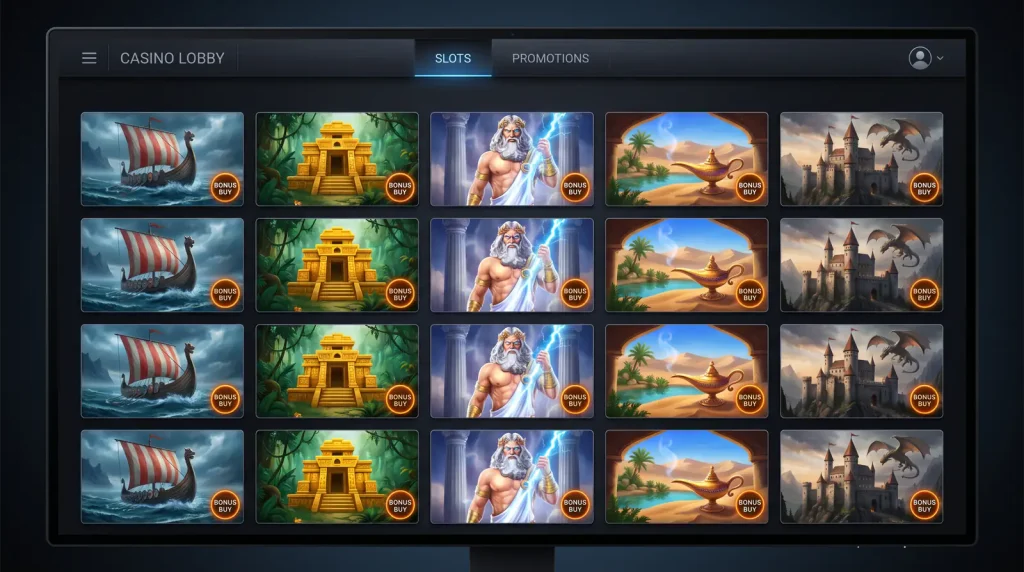
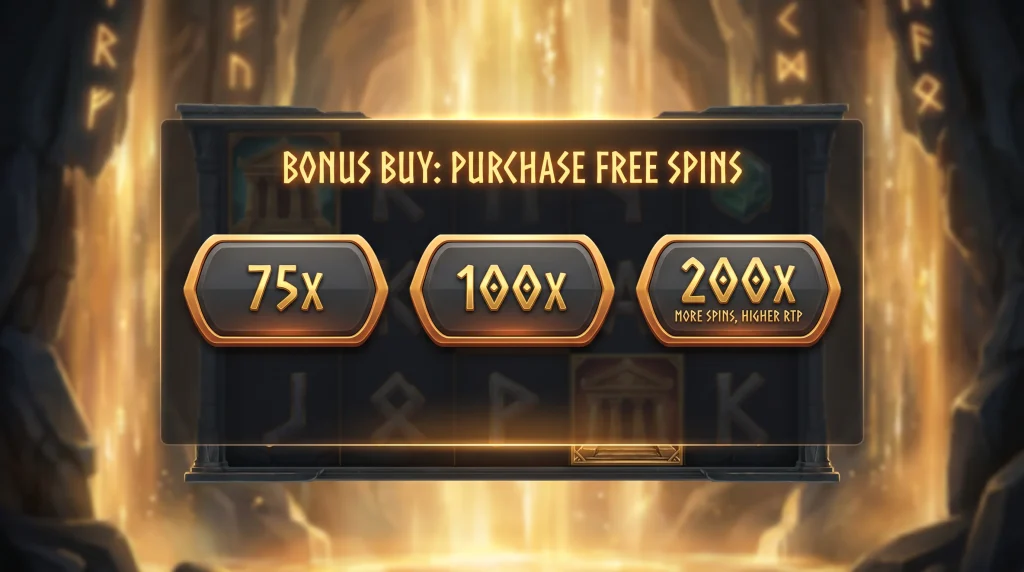
From Nolimit City, the obvious anchors are San Quentin xWays, Tombstone R.I.P., Mental, Fire in the Hole xBomb and the more recent Punk Toilet. All of these carry buy-feature pricing in the 75× to 200× range depending on the variant — some titles offer two or three buy tiers at different multipliers. From Hacksaw Gaming, Wanted Dead or a Wild dominates, with Chaos Crew, RIP City and Cubes 2 close behind. Push Gaming brings Razor Shark, Razor Returns, Jammin’ Jars 2 and Fat Banker. Pragmatic Play’s contribution — and Pragmatic shows up heavily because the studio holds nine of the top-ten most-played slot positions in UK Q1 2025 charts even outside the UKGC perimeter — includes the Gates of Olympus line, Sweet Bonanza, Big Bass Bonanza derivatives and a long Sticky Bandits sequence. The Pragmatic buys typically sit at 100×.
From smaller studios, Print Studios (Wild Swarm 2), ELK (Tahoe Gold), Relax Gaming (Money Train series) and Yggdrasil (Hades: River of Souls) all have buys at offshore venues. The Money Train titles in particular are interesting because they ship multiple ante-bet stages alongside the headline buy.
What you will not find consistently is the Big Time Gaming Megaways core catalogue with a native buy button — most of the original BTG titles do not carry one. Buy-feature Megaways slots are almost entirely the licensee builds. Anything by Blueprint, Pragmatic, or Red Tiger that runs on the Megaways engine usually carries a buy option offshore. Anything by BTG itself usually does not. That distinction trips up players who assume Megaways is a single product line. It is not. It is an engine with many licensee variants and the buy availability splits along the licensee line.
I would suggest cross-referencing how this interacts with the offshore promo layer — how bonus-buy purchases interact with welcome offer wagering is its own conversation, because most welcome offers explicitly exclude buy-feature stakes from contributing to wagering progress.
What a 100× Buy Costs Across Five Popular Slots
Numbers ground the abstraction. Here is what a single 100× buy at a £1 base stake actually costs on the most-bought titles I see offshore. I am using a £1 reference because it is the standard non-GamStop entry stake and the maths scales linearly to your own.
San Quentin xWays buys at 100× — £100 per buy. The buy-feature RTP runs slightly above base RTP at 96.03% versus a base of around 96%. Expected loss per buy: £3.97. Volatility is exceptionally high.
Wanted Dead or a Wild from Hacksaw buys at 100× as well, £100 per buy. RTP on the buy is 96.38%. The expected loss per buy of £3.62 is similar in magnitude to the Nolimit title, but Hacksaw’s variance distribution is differently shaped — bigger drought clusters between paying buys, leaner average per-buy wins.
Razor Shark from Push Gaming buys at 100×, £100. Buy RTP comes in at about 96.7%, slightly more generous than the Hacksaw or Nolimit comparators. The high-RTP tier of mainstream slot titles starts at around 97%, with the very top of the market at 99% for Mega Joker, so 96.7% is solidly mid-pack rather than market-leading.
Sweet Bonanza from Pragmatic buys at 100× — £100 — at 96.48% RTP. Money Train 4 from Relax Gaming carries a 200× buy stage, meaning £200 from the same £1 base, at 96.1% RTP, with expected loss per buy near £7.80.
Across the five titles, the expected loss per 100× buy at a £1 base is in the £3.50 to £8 range. Across many buys, that converges on the published RTP. Across a single session, the variance dwarfs the expected value to the point that the figure becomes meaningless on a per-buy basis. Long-run only.
Why did UKGC remove the bonus-buy feature from licensed slot sites?
The removal sits inside the UKGC"s online slots design rules, which took effect on 31 October 2021 and were reinforced by the 2023 Gambling Act Review White Paper. The regulator"s stated reasoning was harm reduction: buy features compress session length, allow players to spend a hundred or more base stakes in a single transaction, and accelerate the rate at which a player can experience large losses. UKGC research framed the mechanic as structurally accelerating loss potential, particularly for players prone to chasing. The ban applies to any slot offered to British customers on a UK remote licence, which is why the feature persists at offshore lobbies that do not hold such a licence.
Can a player still buy a feature with welcome bonus funds at a non-GamStop site?
Sometimes, but it is the exception rather than the rule. Most non-GamStop welcome offers explicitly exclude buy-feature wagers from contributing to bonus playthrough, and a meaningful number prohibit buy purchases entirely while bonus funds are active. The terms vary by operator and even by promotion — a welcome package may allow buys but a reload offer at the same operator may not. The practical effect is that buy features are usually a separate-cash mechanic offshore, not a bonus-funded one, and players who try to use bonus balance for buys often see the bonus voided. Read the specific promotion terms before assuming a buy is permitted.
Is the RTP higher or lower when a player triggers a bonus through a feature buy?
It depends on the title — and the gap is usually small. Studios configure buy-feature RTP independently from base-game RTP, and the design choice goes either way. On Nolimit City"s San Quentin xWays the buy sits a fraction above base RTP, while several Pragmatic Play and Push Gaming titles ship buys at slightly lower RTP than the base game. The hit frequency inside the feature round itself is fixed by the maths model and does not change between buy-triggered and naturally-triggered features. What changes is the price you pay to access that round and the long-term cost per buy, which is settled by the configured buy RTP and not by how lucky the round happens to be.
Articles
Created by the "non Gamstop slots UK" editorial team.