
High Volatility Slots Not on GamStop and Variance Risk
 Available in GB
Managing Bankrolls on High Volatility Slots
I sat next to a player at an industry event in 2024 who told me proudly that he played only high-volatility slots because he wanted “the chance at the big win.” I asked him how often he had hit a 1 000× spin. He said three times in eight years. He had been spinning ten to twenty hours a week through most of that period. That, in microcosm, is what high volatility actually costs — most of it is the long drought between the events you remember.

The marketing language around volatility consistently inverts the reality. High-volatility titles are not “more chance at the big win.” They are titles where most of your wagered pounds buy you nothing and a small percentage of them buy you everything. The distribution is bimodal. Long base-game droughts punctuated by rare feature rounds that pay disproportionately. The average return — the RTP figure — converges only across tens of thousands of spins. Anything shorter is variance, and on high-volatility titles the variance dwarfs the trend.
This matters at offshore venues specifically because the UK 18–24 player segment shows a 21.9% rate of any PGSI scoring above zero, with 5.3% in the highest risk category. High-volatility slots interact poorly with that risk profile. The mechanic structurally rewards extended play and provides intermittent reinforcement at exactly the cadence that conditioning research flags as the most habit-forming. That is the backdrop. Now to the mechanics.
Volatility as Standard Deviation: A Non-Marketing Read
Volatility is a statistical measurement. It is not a marketing adjective. Specifically, it is the standard deviation of returns on a single spin around the slot’s mean return. A low-volatility slot has a tight distribution — most spins return something close to the expected value of that spin. A high-volatility slot has a wide distribution — most spins return zero, a small number return large multiples, and the mean works out only over very large samples.
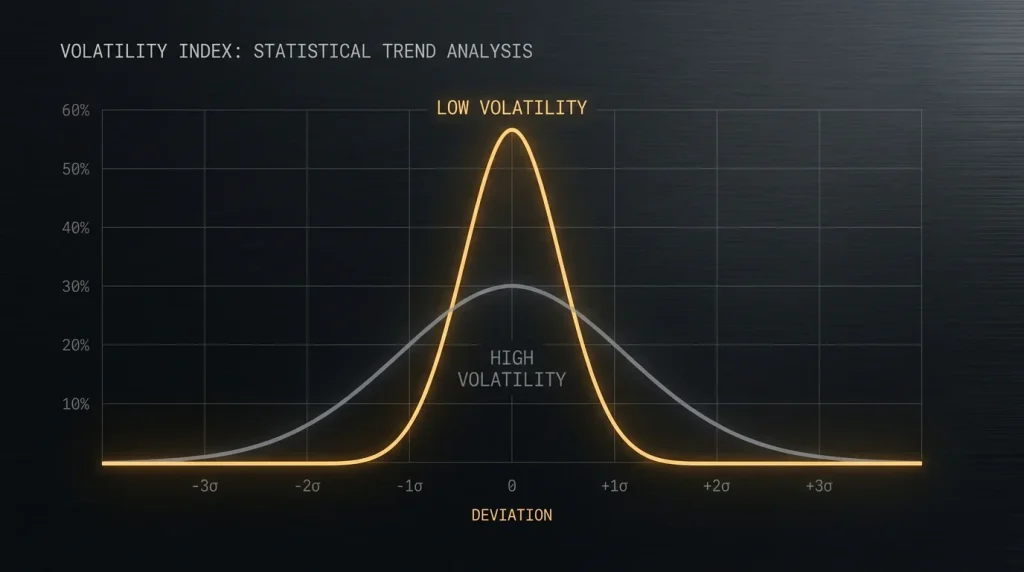
Studios publish volatility ratings on a 1-to-5 or 1-to-10 scale that maps roughly to standard-deviation bands. A “5/5” volatility rating typically corresponds to standard deviations above 20 per spin at a unit stake, with some titles pushing past 30. For context, a low-volatility classic with a tight payline structure runs around 4 to 6 standard deviations. The high end sits in a fundamentally different statistical regime.
The practical translation: at a 5/5 volatility rating with an RTP of 96%, you can spin 500 base-game rounds and end the session having returned anywhere from 5% of your total wager to over 200%. The expected value is 96%. The actual session result has almost no relationship to that figure inside a few hundred spins. Five thousand spins narrows the range. Fifty thousand brings the mean into view. Most players do not approach that sample size in a single session, week, or month.
RTP and volatility sit on independent axes. A title can be high RTP and low volatility, low RTP and high volatility, or anywhere in between. The two figures together define the bankroll requirement and the session character — I cover the RTP side at the relationship between RTP and the volatility curve.
High Volatility Titles at Non-GamStop Sites
Offshore lobbies are overweighted in high-volatility releases because most of the studios that specialise in the design language sit either fully outside UKGC (Nolimit City, Hacksaw Gaming) or sit awkwardly inside it with reduced catalogue presence (Print Studios, ELK on the more extreme titles).

From Nolimit City: Tombstone R.I.P., San Quentin xWays, Mental, Fire in the Hole xBomb, Punk Toilet, Outsourced and Misery Mining all run at the top of the volatility scale. Max-win caps on these sit at 30 000× to 100 000× stake. Mental’s published 100 000× cap is the often-cited extreme — that win has been recorded a handful of times in public stream sessions and the practical hit rate is in the single-digit-per-million-spins range.
From Hacksaw Gaming: Wanted Dead or a Wild, Chaos Crew 2, Cubes 2, RIP City and the broader Hacksaw Originals catalogue all sit in the same volatility band. Hacksaw caps most titles at 25 000× to 100 000×. The studio’s design language compresses base-game variance even tighter than Nolimit — drought windows of 200 to 500 spins between meaningful pays are normal.
Push Gaming brings Razor Shark, Razor Returns, Jammin’ Jars 2 and Fat Banker. Razor Shark’s max-win sits at 50 000× and the title is widely considered one of the most genuinely playable high-vol slots — the feature triggers relatively often even if the maximum payout is rare. From Print Studios: Wild Swarm 2 and Boom Pirates. From ELK: the X-iter family. From Relax Gaming: the Money Train series, capped at up to 50 000×. From Pragmatic Play — which carries nine of the top-ten most-played slot positions on UK Q1 2025 charts — Sweet Bonanza, Sugar Rush 1000, and the Big Bass Bonanza derivatives all sit in the high-volatility band, though typically a step below Nolimit and Hacksaw on raw standard deviation.
Bankroll Sizing for a 20 000× Slot
Here is the maths every player should run before depositing for a high-volatility session. Bankroll requirement scales with the title’s variance, not with intuition.

For a slot with a 20 000× max-win cap, expected feature trigger frequency around 1-in-200 spins, and feature-round expected payout averaging 30× to 50× stake, the bankroll needed for an 80% probability of seeing one paying feature is roughly 500× your base stake. At a £1 base, that is £500. For a 95% probability of seeing one paying feature: roughly 1 000× base stake, or £1 000 at a £1 stake. For a meaningfully high probability of seeing a 1 000× win or greater inside the session: substantially more than that — and the marginal probability gain per additional pound spent flattens fast.
That is not a recipe. It is a probability calculation. The high-RTP band of mainstream slot titles starts at 97% with Mega Joker at 99% and 1429 Uncharted Seas at 98.6%, but the high-volatility offshore catalogue mostly sits at 96% or below — meaning theoretical loss on the full bankroll is between 4% and 5% in expectation, on top of the variance.
What this means in plain English: a £500 bankroll on a 20 000× slot carries a roughly 50% probability of being fully consumed inside the session, a 30% probability of breaking roughly even, and a 20% probability of seeing a feature outcome that returns the bankroll several times over. The expected value of the £500 is around £480. Most players see one of the two extremes, rarely the middle.
Player Profiles That Should Not Touch High-Vol Slots
I am not in the business of telling people what to do with their money. But high-volatility slots are mathematically hostile to certain player profiles, and there is no marketing framing that changes the maths.

Anyone whose session bankroll is below 200× the minimum base stake on the title should not be playing it. The probability of fully losing the bankroll without ever seeing a feature is too high to make the session anything other than a deposit walk.
Anyone with any indicator on the PGSI screening tool should be especially cautious. The Adult Psychiatric Morbidity Survey for England found 0.3% of adults meet the clinical threshold for problem gambling, with 0.9% among those who gambled in the last 12 months — and 1.6% of all English adults sit at PGSI 3 or above, meaning at least moderate risk. High-volatility slots structurally interact with that risk profile in worse ways than lower-volatility titles, because the long base-game droughts encourage chasing behaviour and the rare feature wins reinforce the chase.
Anyone playing on borrowed money or to recover earlier losses. The variance regime makes that approach mathematically and behaviourally untenable.
Is a high-volatility slot more profitable than a low-volatility one in the long run?
No. Volatility describes the spread of outcomes around the mean, not the mean itself. The expected return — the RTP — is set independently of volatility. A high-volatility slot at 96% RTP and a low-volatility slot at 96% RTP have the same expected loss per pound wagered over a long enough sample. What differs is the path. The high-volatility slot has wider session-to-session swings, larger possible single-event wins, and longer drought windows between paying events. The low-volatility slot delivers a steadier flow of small wins. Neither is more profitable in expectation. Both lose money at the same theoretical rate per spin.
Why are high-volatility slots overrepresented at non-GamStop sites?
Because the studios that build high-volatility catalogues are concentrated outside the UKGC perimeter. Nolimit City, Hacksaw Gaming, Print Studios and parts of Push Gaming and Relax Gaming either skip UKGC distribution entirely or ship reduced versions to it. The buy-feature mechanic that anchors most high-volatility designs is itself banned from UKGC slots since 31 October 2021. The stake-cap and bonus-wagering rules that UKGC enforces also pinch the design language. Studios that build for the offshore market keep the original design parameters intact and route the catalogue through Curaçao, Anjouan and MGA licences rather than UK ones.
How does volatility interact with bonus wagering at offshore operators?
Badly for the player on most welcome offers. High-volatility slots typically have the longest path to converting bonus funds into withdrawable cash because the wagering condition requires turning the bonus over a fixed number of times — usually 35× to 45× at offshore venues — and high-volatility variance frequently busts the bonus balance before the wagering target is met. Most offshore operators also explicitly cap max-bet during bonus wagering at £5 or lower, which interacts awkwardly with high-volatility titles that need larger stakes to land meaningful wins. Read the bonus terms specifically for high-volatility slot eligibility — some operators reduce game weighting on these titles below 100%, effectively raising the wagering requirement further.
Articles
Prepared by the non Gamstop slots UK editorial staff.