
Jackpot Slots Not on GamStop and Progressive Network
 Available in GB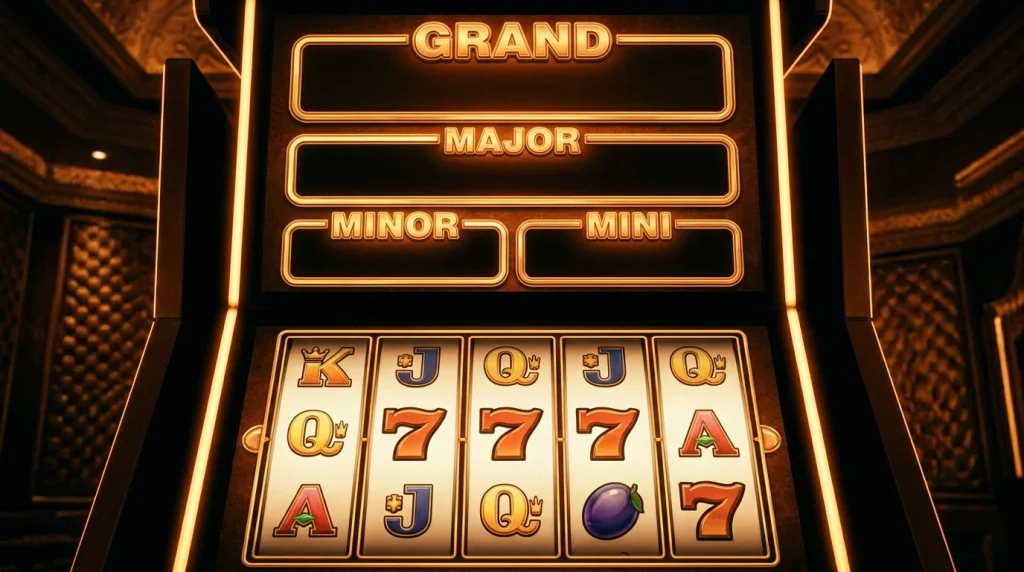
Funding Mechanics for Progressive Jackpot Slots
The first jackpot slot I ever broke down line by line was Mega Moolah in 2018, and I came away with a single takeaway I have not budged from since: the jackpot layer is not the slot. It is a lottery sitting on top of the slot, funded by a small per-spin contribution, with its own probability distribution that has almost nothing to do with the base game’s hit frequency. UK players who walk up to a jackpot slot at any venue — UKGC or offshore — often miss that distinction.

The offshore environment puts a different spin on the same architecture. Unlicensed operators pulled £379 million from UK audiences in the first half of 2025 alone, and a meaningful chunk of that flowed through jackpot-tagged lobbies because the headline figures are the most marketable thing in the entire slot category. Derek Webb at the Campaign for Fairer Gambling has called Great Britain a soft touch on this question — meaning the regulator’s reach into how offshore jackpot pools are funded, displayed and capped is essentially nil. That is the starting condition for everything below. The jackpot you see displayed at a non-GamStop site is a number the operator chooses to display. Whether it is also the number that pays is a separate question.
Progressive, Fixed, Daily Drop & Hold-and-Win Types
Four jackpot architectures cover everything you will see at offshore slot lobbies. Knowing which one you are looking at is the difference between a sensible read and a marketing-led one.
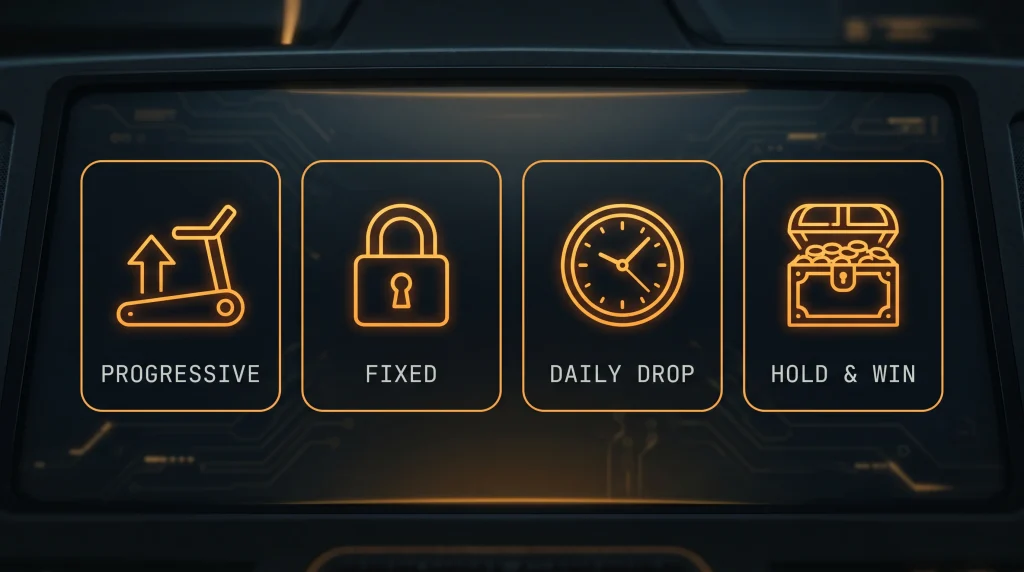
Progressive jackpots grow with each contribution from each spin across the contributing network, with no upper bound. They are seeded at a base value, climb until won, then reset to seed. Classic example: the wide-area progressive networks that link multiple operators to a single jackpot pool. Win probability per spin is fixed and very low. Average win frequency at the top tier on a wide-area network is typically months or years.
Fixed jackpots pay a published, unchanging amount on a defined trigger. They look like progressives but the displayed figure does not move. Most “jackpot” slots that are not flagged as progressive are fixed jackpots in disguise.
Daily-drop jackpots are time-bounded progressives that are guaranteed to pay before a specified hour each day. The pool grows from a seed across the contributing period, with the win triggered by a randomised mechanism that biases more strongly toward the cap as the deadline approaches. They are conceptually a forced-resolution variant of the progressive model.
Hold-and-Win jackpots — and these dominate offshore lobbies in 2026 — are a different architecture entirely. They are integrated jackpot rounds, triggered by collecting bonus symbols on the reels, where the player ends up with a guaranteed prize from a set of pots labelled Mini, Minor, Major and Grand. The Grand is typically a fixed multiplier of stake rather than a true progressive. The mechanic was popularised by Pragmatic Play’s Money series.
Recommended online casinos
- ChanzeBonus: Slots Welcome Bonus #1 200% up to €500 · Payout speed: 1-3 business days
- ZombillionBonus: Welcome Pack 250% up to £4000 + 200 FS · Payout speed: 1-3 business days
- NightWinBonus: £900 + 400 free spins · Payout speed: 1-3 business days
- WinBeastBonus: €5000 + 500 FS + €650 Freebet · Payout speed: 1-3 business days
- EvoSpinBonus: 125% up to €2500 + 125 Free Spins · Payout speed: 1-3 business days
- SlotoSportBonus: 500% up to £ 10 200+ 777 FS · Payout speed: 1-3 business days
- BritsinoBonus: Welcome Package – Get your £2,200 + 2,000 FS · Payout speed: 1-3 business days
- BeOnBetBonus: 100% up to €500 + 100 FS · Payout speed: 1-3 business days
- AmunbetBonus: Join now and get 450% up to 2,700 GBP + 450 FS · Payout speed: 1-3 business days
Network Jackpots vs Operator-Local Pots
Two structural distinctions decide whether the jackpot figure on your screen is meaningful. The first is whether the pool is networked or local.

Network jackpots collect contributions from spins across multiple operators that share a single jackpot infrastructure — usually run by the game studio or a specialist jackpot network. Pool sizes are large because the contributor base is large. Win probability per spin is small for the same reason. The pool is administered by the network, not the operator, which means the operator does not control the payout flow.
Operator-local jackpots are pools that collect contributions only from spins at a single operator. Pool sizes are smaller. Win probability per spin is correspondingly higher — but this matters less than people assume because the typical local pool is two to three orders of magnitude smaller than a network pool.
The offshore environment introduces a third category that is rarer at UKGC venues: opaque pools, where the funding mechanism is not disclosed and the displayed figure is not auditable against contribution flow. These are usually local pools dressed up to look like network pools. The marketing distinction matters because a £2 million local pool is funded from a single operator’s spin flow and will take longer to grow back after a hit than a network pool of equivalent size — sometimes long enough that the displayed figure stays high after the win for marketing reasons rather than because new contributions have actually built it back.
Jackpot Titles at Non-GamStop Sites & Their Seed Values
Here is what currently surfaces on most offshore lobbies, with the seed values I have observed across recent post-win cycles. Seeds are the floor — the figure the jackpot resets to after it pays — and they tell you more about a jackpot’s character than the live display does.

Pragmatic Play’s Money series — Money Train 4 jackpot variants, Mustang Gold, Buffalo King Megaways jackpot edition — anchors the Hold-and-Win category at offshore lobbies. Pragmatic carries nine of the top-ten most-played slot positions on UK Q1 2025 charts and the same dominance translates into jackpot-tagged play. The Grand pot in the Money series typically tops out at 5 000× to 10 000× stake — high but not unbounded. The Major sits at 100× to 500× stake. Mini and Minor pots resolve into stake-multiple amounts under 50×. I cover the studio’s wider catalogue at the studio that dominates hold-and-win jackpot networks.
From the wide-area progressive category at offshore venues, Mega Moolah continues to anchor the segment with a Grand seed of £1 million. Hall of Gods (NetEnt) seeds around £1.5 million on the top tier. Mega Fortune seeds at around £1 million on its Mega jackpot. These three were the dominant network progressives at UKGC venues for years and remain the most consistently available offshore equivalents.
Daily-drop categories: most offshore venues run a Pragmatic Drops & Wins jackpot tagged onto a rotating set of titles, with daily-drop pools resetting under £1 000 and capping around £5 000. Some operator-specific daily drops sit at higher caps but with smaller contributing flow.
Operator-local progressives at offshore venues are the category I am most cautious about because the funding mechanics are rarely disclosed. The seed values are not reliably comparable. Treat operator-local jackpot displays as marketing rather than maths until you can verify the pool architecture.
The Honest Maths of Jackpot Win Probabilities
I will give the numbers straight because the maths is the entire point. The top tier of a wide-area progressive jackpot pays approximately once every 30 to 50 million spins on average, depending on the title and network configuration. At a base stake of £1, a single player would need to spin every second for a continuous 380 to 630 days to expect one top-tier hit. At a £0.20 stake — five times more spins per pound — it is the same number of spins, so the same expected timeline. The contribution rate from each spin into the jackpot pool is typically between 0.5% and 2% of stake.

The base RTP of a jackpot slot is usually published net of the jackpot contribution, which means the displayed RTP — often in the 92% to 94% range — sits below the wider market. The high-RTP band of mainstream slot titles starts at 97%, with Mega Joker at 99%, Blood Suckers at 98% and 1429 Uncharted Seas at 98.6%. A jackpot slot at 93% is giving up four to six percentage points of theoretical return in exchange for the long-tail chance at the headline figure.
Hold-and-Win jackpot titles are different. The integrated jackpot is part of the base maths, the contribution is baked into the RTP rather than skimmed off it, and the Grand-tier multiplier is a fixed maximum rather than a true progressive. The expected value of the integrated jackpot is captured in the overall RTP, which often sits closer to mid-pack.
How is a progressive jackpot funded at a non-GamStop slot site?
Through a percentage skim from every contributing spin. The skim is typically between 0.5% and 2% of stake and is deducted from the published RTP — which is why most progressive jackpot titles display a base RTP in the 92% to 94% range, several points below the mainstream slot baseline. On a wide-area progressive, the skim flows to a network operator who administers the pool across multiple operators. On a local progressive, the skim stays with the single operator. Offshore lobbies do not have to disclose the contribution rate or the network architecture, so verifying which model is in play often requires checking the studio”s published maths sheet rather than the operator”s lobby copy.
Can a non-GamStop site cap a jackpot payout below the displayed value?
In principle no for true network progressives, where the payout is administered by the network and the operator is not the paymaster. In practice, yes for almost everything else. Operator-local jackpot pools, hold-and-win Grand tiers and most daily-drop jackpots have caps written into the operator”s terms — sometimes a maximum cashout per transaction, sometimes a maximum payout per jackpot event, sometimes a delayed-payout schedule for amounts above a threshold. The terms vary by operator and the displayed figure on the lobby is rarely the only number that matters. Read the maximum-payout terms and the cashout schedule before assuming the displayed pot equals the wire transfer.
Do daily-drop jackpots actually pay out on the displayed schedule?
Yes, with caveats. The daily-drop architecture is designed to force resolution before the displayed deadline, and reputable studio-administered daily-drop networks — Pragmatic Drops & Wins, Red Tiger Daily Drop — do force the payout. The mechanism that selects the winning spin biases more strongly toward the cap as the deadline approaches, so the win is statistically near-certain to land within the displayed window. The caveat is what happens between the win and the credit on your account. Daily-drop wins on operator-administered local pools can sit in pending review for several days before crediting, even when the win itself was forced on schedule.
Articles
Prepared by the non Gamstop slots UK editorial staff.